

A Tribute to the Pioneer Who Changed College Football Forever
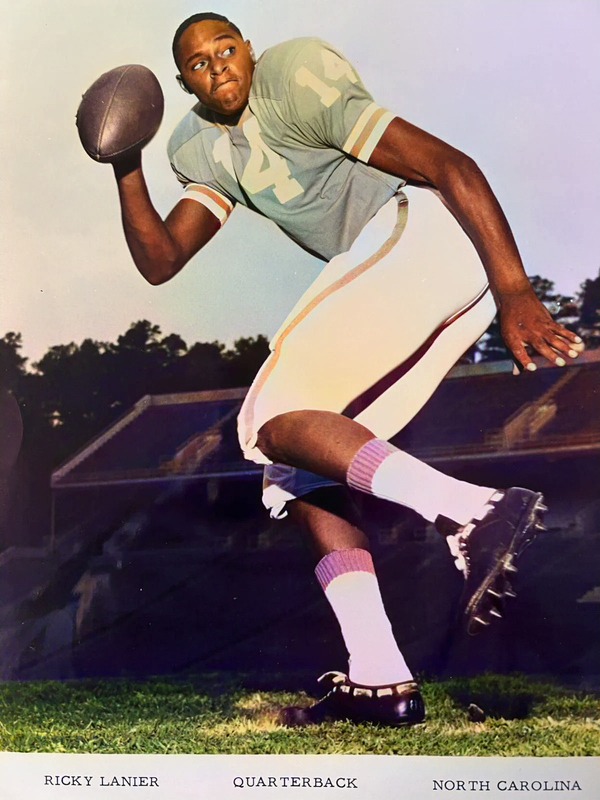
The Weight of the Door: Remembering Ricky Lanier
Sometimes you don’t fully understand the weight of a door until you walk through it.
When I took my first snap as starting quarterback at the University of North Carolina in the late 1980s into the early 90s, I stood on ground that Ricardo “Ricky” Edwin Beaumont Lanier had consecrated two decades earlier. In 1967, when he became the first Black scholarship football player at UNC, Lanier didn’t just step onto Kenan Stadium’s turf—he walked through a door that had been locked for generations, carrying more than a football in his hands.
He carried the hopes of a community that had been told to wait. The weight of centuries of exclusion. And the crushing responsibility of proving what should have never needed proving: that greatness recognizes no color, that leadership isn’t determined by melanin, that a Black man could think, command, and excel at the most cerebral position in sports.
Without Ricky Lanier’s courage, my own journey would not have been possible. His passing on October 1, 2025, at the age of 76, demands more than our grief. It demands our remembrance, our gratitude, and our commitment to honor the path he cleared with such grace and excellence.
Throwing at Trees in Williamston
Before Chapel Hill knew his name, Williamston witnessed something extraordinary taking shape. At 135 pounds, young Ricky Lanier caught the eye of legendary Coach Herman “Ike” Boone—yes, that Coach Boone from Remember the Titans. Over one summer, Lanier transformed himself, bulking up to 170 pounds by lifting weights. But it was what he did alone that reveals the depth of his dedication: taking snaps in his yard, fading back, going through progressions, then throwing the ball at trees.
Think about that image. A young Black teenager in 1960s North Carolina, practicing quarterback—a position the world told him wasn’t for him—by throwing at trees because he believed in what was possible before anyone else did.
In 1967, against Snow Hill, Lanier didn’t just dominate—he transcended the game itself. Five passing touchdowns. Eight rushing touchdowns. Thirteen total touchdowns in a single game. Final score: 80-0. More than five decades later, that North Carolina state record still stands, untouched and perhaps untouchable.
But here’s what the stat sheet couldn’t capture: Lanier was doing this at a time when Black quarterbacks were routinely told they weren’t “smart enough” to play the position. Every touchdown pass was a refutation. Every rushing score was an answer to a question that should never have been asked. And he was doing it while earning recognition as a National Merit Scholar finalist.
“Larry and Charlie Were Just Honest With Me”
When it came time to choose a college, the big programs came calling—Michigan State, Ohio State, Purdue. Their recruiting visits felt, as Lanier put it, “orchestrated.” Then came Chapel Hill, which he wasn’t even considering.
The welcoming committee was unlike any other: head basketball coach Dean Smith, Charlie Scott—the first Black scholarship athlete in UNC history—and Scott’s teammate, future Hall of Fame coach Larry Brown. There was no formal coaching staff yet assembled, so two basketball players took on the responsibility of hosting him.
“Larry and Charlie were just honest with me about what to expect,” Lanier recalled years later. “I didn’t think twice about being the first, but Larry and Charlie just did such a good job.”
Scott knew exactly what Lanier would be walking into because he’d already walked through it himself. That honesty, that fellowship, that passing of the torch from one pioneer to another—it mattered. When Lanier visited Chapel Hill, “it seemed more folksy,” he said. “They were more concerned about me, and that’s what changed my mind.”
He chose to be first. To be the one who opened the door.
One Afternoon at Kenan Stadium
The story goes that starting quarterback John Swofford went down early with an injury in a 1969 game against VMI. It was time for Ricky Lanier to show he was more than capable of directing an offense, to answer the stereotype that said he couldn’t.
“We were running another run-pass option, and I would put the ball in Don McCauley’s belly, and if the tackle pressed and tackled Don, I would take it out and run around end,” Lanier explained. “The only thing is, they had defensive backs and safeties coming down to stop Don, so when I got around the end, there was nobody. So I had these long runs.”
When the game ended, Lanier had rushed for 174 yards—a UNC record for a quarterback in a single game that stands more than fifty years later. He also threw for 136 yards. Swofford, who would go on to become ACC Commissioner, remembered it clearly: “What I remember about that day is Ricky’s day, because he had such a great day.”
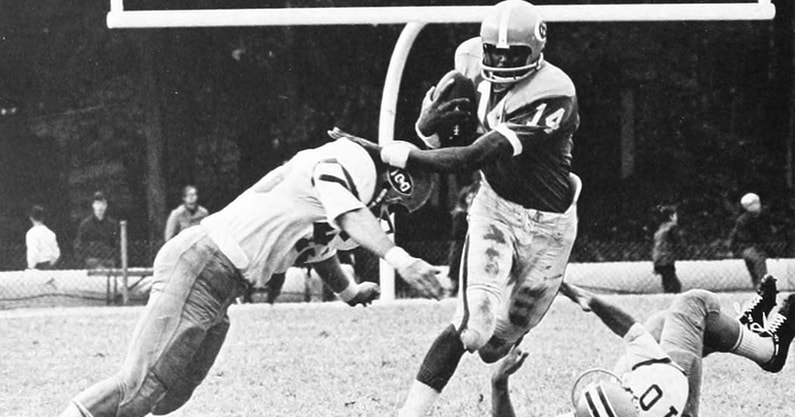
Lanier himself insists the record should read 199 yards. “Coach Dooley said I had 199, then I got sacked for 25 yards,” he said, laughing about it years later. Even in defending his own achievement, there was that characteristic grace, that ability to find humor in the frustration.
But here’s what breaks your heart: that was the last time Ricky Lanier played quarterback for the Tar Heels.
“I Wasn’t Going to Transfer”
By the 1970 Peach Bowl against Arizona State, Lanier was catching passes, not throwing them. Two receptions for 50 yards. When the season ended, so did his dream.
“But after that game, I went right back to wide receiver,” he recalled. “And that’s when I just knew it was just over.”
He could have left. He could have transferred to one of those Big Ten schools that had recruited him. But listen to what he said: “And back then, you didn’t transfer. I wasn’t going to transfer because that would be like throwing red meat to dogs, those naysayers. So, I stuck it out. I finished.”
Even in this moment—when he had every right to be angry, to feel cheated, to walk away—Lanier thought about what it would mean to leave. He understood that quitting would become ammunition for those who never wanted him there in the first place. So he stayed. He excelled at wide receiver. He graduated in 1970.
This is the cost of being first that statistics never capture. The loneliness. The weight of representation. The burden of knowing that your choices don’t just affect you—they affect everyone coming after you.
Teammate Ike Oglesby remembered that when the staff first wanted to move Lanier to receiver, “Ricky didn’t like it at first, and because of that, he decided he was not going to come to practice for two days.” That small act of resistance matters. Lanier stood up for himself, even as a Black athlete in 1960s North Carolina, even when resistance could have cost him everything. Then he made the calculation that finishing was more important than fighting.
That’s not weakness. That’s a different kind of strength entirely.
The Songs We No Longer Sing
There’s another part of Lanier’s legacy that deserves remembering. “The playing of ‘Dixie’ at basketball and football games was just uncomfortable for us,” he said. So the Black athletes met with Coach Dooley, Coach Dean Smith, and Chancellor Sitterson.
“After that meeting, they stopped playing it,” Lanier recalled. “I wouldn’t call it a demand. We didn’t refuse to play, we just didn’t like it.”
That careful language—”I wouldn’t call it a demand”—tells you everything about the tightrope these young men walked. They had to be strong enough to speak up but diplomatic enough not to threaten. Brave enough to challenge tradition but gracious enough not to seem ungrateful for the opportunity they’d been “given.”
And yet, they succeeded. Because of Lanier and his Black teammates, generations of athletes no longer had to stand for a song that celebrated the Confederacy. That’s legacy. That’s change. That’s what courage looks like in real time.
A Teacher’s Heart
After graduation, Lanier coached at North Carolina Central and worked for IBM. But eventually, he followed his parents’ legacy into education, teaching earth and environmental science at Western Guilford High School in Greensboro for 17 years before retiring in 2016.
His former schoolmate Larry Biggs captured something essential about him: “Ricky was a hero to a lot of people, including me. He was a really nice guy and a smart guy. Even after he got all those accolades, he was very personable. He was always kind.”
Mütter Evans, who played in the band at Hayes High, remembered him as “just a free-spirited guy.” Evans added, “He was always respectful to everyone. A few close friends, but probably, a lot like me, more of a loner than a hanger.”
There’s something poignant in that description—this pioneering figure as someone who was “more of a loner,” someone who maintained a small circle, someone who was kind and respectful but perhaps carried his burdens quietly. Being first is often lonely. The door you walk through, you walk through alone.
Yet Lanier never let that loneliness harden into bitterness. He remained “personable,” “kind,” “free-spirited.” That might be his greatest achievement—not just opening doors, but refusing to let the weight of those doors crush his humanity.
Ahead of His Time
In 2014, when UNC recognized him as one of the first Tar Heel Trailblazers, Lanier was still paying attention to the game. He praised quarterback Marquise Williams: “I really like the way Marquise plays the game, where he’ll put pressure on the defense and run or pass.”
Then he added, with that characteristic humor: “I was a little ahead of my time, I think.”
In more ways than one, Ricky.
In 2022, Riverside High School in Williamston honored him for “breaking barriers and setting an example for our future student athletes.” Athletic Director Phil Woolard understood what was at stake: “Our young people need to know the stories of Mr. Lanier and his teammates. On and off the field, there are so many lessons we can take from them.”
The Doors That Remain Open
When I think about Ricky Lanier now, I think about those trees in his Williamston yard, absorbing throw after throw from a kid who refused to accept the limitations the world tried to place on him. I think about his sitting in a hotel room after meeting Larry Brown and Charlie Scott, making the decision to be first because someone had to be.
I think about him standing on that field against VMI, finally getting his chance, running for what should have been 199 yards, proving everything that should never have needed proving. And then I think about him going back to wide receiver, finishing what he started, graduating with dignity intact.
I think about him standing up—carefully, diplomatically, but firmly—and saying “Dixie” made him uncomfortable. And I think about him spending 17 years teaching science to young people, showing them by his example what it means to be both brilliant and kind, pioneering and humble.
For those of us who followed in the paths he cleared, who benefited from the doors he opened, who stood on the shoulders of his courage—we owe him more than memory. We owe him emulation. Not just of his athletic excellence, but of his complete commitment to being fully human in circumstances that constantly tried to make him less than that.
When I took my first snap at UNC, I didn’t fully understand the weight of the door I walked through. Now I do. Ricky Lanier held it open, even when it was crushing him. He held it open with grace. With excellence. With quiet dignity. With kindness.
He held it open so we could walk through.
Ricardo “Ricky” Edwin Beaumont Lanier (1948-2025)—Pioneer, Scholar, Athlete, Teacher, Trailblazer.
The door you opened remains open. Your name is written on it. And everyone who walks through it walks in your light. Thank you, sir.
Packed House Sports honors the legacy of Ricky Lanier.