
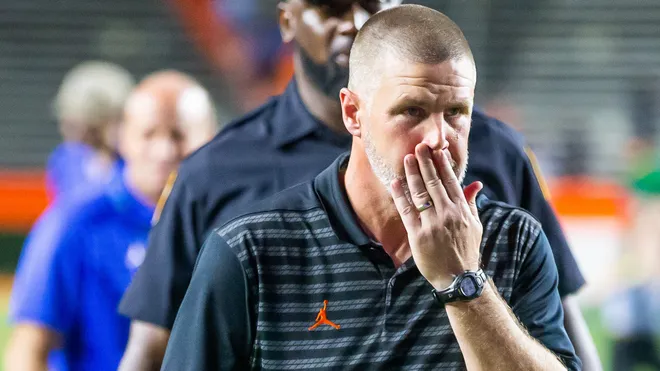
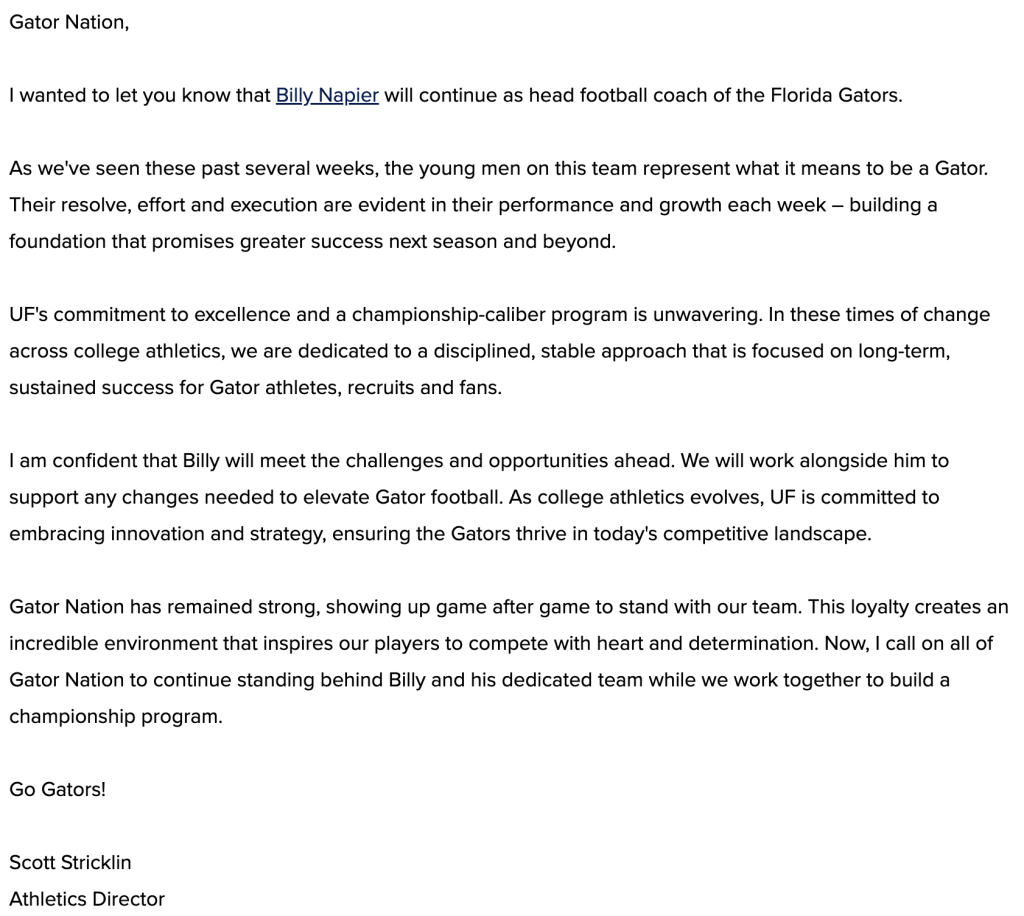
Florida Gators’ athletic director Scott Stricklin recently announced that Billy Napier will continue as the head football coach, a decision that has sparked varied reactions among fans. Here is the letter from Stricklin to Gator Nation:
Context of the Decision
Despite a current record of 15-18 under Napier and concerns about another potential losing season, Stricklin’s announcement aims to quell speculation regarding Napier’s job security. This decision comes at a time when Florida is facing tough competition and must navigate critical upcoming games.Overall, Stricklin’s letter reflects a commitment to continuity and support for Napier as he seeks to turn around the program, despite ongoing challenges and fan discontent regarding past performances.
Fan Response
But the decision to retain Billy Napier as head football coach of the Florida Gators has been met with skepticism and disappointment from many fans. Here’s an exploration of why this decision is viewed negatively by a significant portion of the Gator Nation:
Underwhelming Performance
Billy Napier’s tenure at Florida has been marked by disappointing results. With a 15-18 overall record and an 8-13 SEC record over three seasons, Napier has failed to meet the high expectations of the Florida football program. The Gators’ struggles against ranked opponents (2-13) and rivals (1-10) have been particularly concerning for fans who expect their team to compete at the highest level.
Historical Implications
Napier is on track to become the first Florida coach since before World War II to lead the program to three consecutive losing seasons. This historical low point is difficult for fans to accept, especially given Florida’s rich football tradition and recent success under previous coaches.
Lack of Visible Progress
While the athletic department cites growth and a promising foundation, many fans struggle to see tangible improvements on the field. The team’s inconsistent performances and inability to close out games against top opponents have left supporters questioning Napier’s ability to develop talent and implement effective game strategies.
Recruiting Concerns
Despite Napier’s reputation as a strong recruiter, the team’s on-field struggles have raised concerns about Florida’s ability to attract and retain top talent. Fans worry that continued mediocrity could harm the program’s recruiting efforts in the highly competitive SEC landscape.
Financial Implications
The decision to retain Napier comes with significant financial considerations. His buyout, estimated at over $20 million, likely played a role in the decision to keep him. Some fans view this as prioritizing financial considerations over on-field success. Context: If Napier were to be fired without cause, Florida would have owed him roughly $27.1 million, per details of his contract as provided to the USA TODAY Network. The $27.1 million buyout was calculated by the 85% of the total remaining compensation on his deal, which is set to run through Jan. 31, 2029.
Competitive Disadvantage
In the ever-evolving landscape of college football, fans fear that sticking with an underperforming coach puts Florida at a competitive disadvantage. With other programs making bold moves to improve, the decision to maintain the status quo is seen as potentially falling behind in the arms race of college football.
Missed Opportunities
Some fans believe that by retaining Napier, Florida may be missing out on the opportunity to hire a more proven or innovative coach who could quickly turn the program around. This sentiment is exacerbated by the success of other programs that have made coaching changes in recent years.
Lack of Accountability
The vote of confidence from the athletic director, despite the team’s poor record, is viewed by some as a lack of accountability. Fans expect results and may see this decision as lowering the standards for what constitutes acceptable performance at a program of Florida’s caliber.
While the administration calls for patience and stability, many in Gator Nation remain skeptical. They question whether Napier can overcome the challenges he has faced thus far and return Florida to its expected position as a perennial contender in the SEC and on the national stage. The coming season will be crucial in determining whether this decision proves to be a wise investment in long-term stability or a missed opportunity to revitalize a struggling program.
Packed House Sports Perspective
Both sides have every right to show confidence, and express concern, around this decision. It’s human nature. A little perspective from experience, confidence in a coach, even during challenging times, can sometimes lead to remarkable turnarounds and long-term success. A prime example of this is Mack Brown’s first tenure at the University of North Carolina. When Brown took over the Tar Heels’ program in 1988, the team was struggling, having won just two games the previous season. Despite initial difficulties, with UNC going 1-10 in Brown’s first 2 seasons, then-Athletic Director John Swofford maintained his faith in Brown’s abilities and vision for the program.
This vote of confidence proved to be a wise decision. Brown gradually improved the team’s performance, leading to a string of successful seasons and bowl game wins. By the time he left UNC in 1997, Brown had transformed the Tar Heels into a consistent top-25 program, with three 10-win seasons and bowl appearances in his final five years. This success at UNC laid the foundation for Brown’s move to Texas, where he would achieve even greater heights, including a national championship in 2005. Brown’s story demonstrates how patience and trust in a coach’s process can pay off, not just for the immediate program but potentially for the coach’s entire career trajectory.
So while scrutiny of a coach’s performance is a natural and fair aspect of any competitive sports environment, it is essential to balance that scrutiny with patience. In college athletics, where expectations run high, fans and stakeholders are right to demand urgency, accountability and results. However, lasting success often requires time for a coach to implement their vision, build a cohesive team, and develop players. NIL has introduced an unpredictable curve of rigor to navigate. Allowing patience to prevail can foster an environment conducive to growth and improvement, ultimately leading to more sustainable achievements in the long run. Embracing this balance can help create a stronger foundation for the program while still holding leadership accountable for their responsibilities.