

There are Olympics, and then there are those rare, once-in-a-generation moments when sport transcends itself entirely and becomes something far more profound. The Milano Cortina 2026 Winter Games delivered exactly that for the United States, as both the men’s and women’s ice hockey teams captured gold medals within days of each other, both times defeating rival Canada in overtime thrillers, and both times producing moments that will be told and retold for decades to come.
The Women Showed the Way
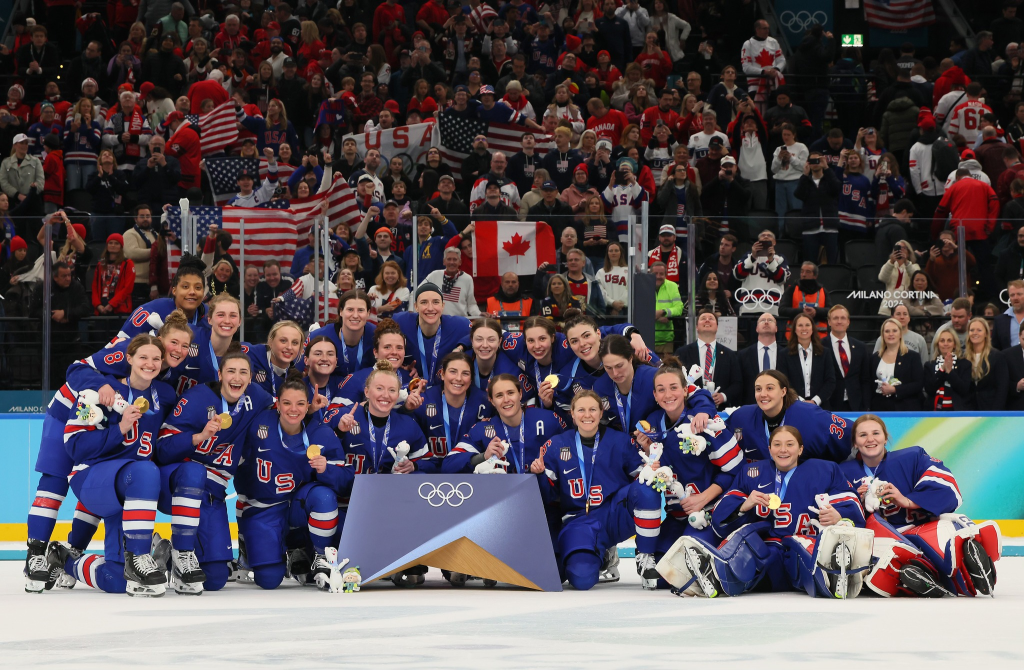
On February 19th, the U.S. women set the table for what was to follow. They entered the gold medal game as dominant favorites, having outscored opponents 31 to 1 across their previous six tournament games in what can only be described as a surgical demolition of the field. Canada, the defending champions, had other ideas. The Canadians silenced the American juggernaut in the second period, slipping a shorthanded goal past goaltender Aerin Frankel on a two-on-two rush, with Kristin O’Neill finishing a beautiful feed from Laura Stacey. The score held heading into the final minutes, and the gold medal dream appeared to be slipping away.
Then came Hilary Knight. With the goalie pulled and the Americans skating six skaters against five, Knight got her stick on Laila Edwards’ shot with just over two minutes left in regulation and redirected it into the net, tying the game and sending the Milano Santagiulia Ice Hockey Arena into pandemonium. It was her 15th career Olympic goal, a new all-time U.S. record, a milestone that placed her in sole possession of history in what would be the final act of her legendary Olympic career. Knight, 36, had already announced this would be her fifth and final Olympic Games, and she had given the Americans one more chance at gold in the most spectacular fashion imaginable. Less than 24 hours earlier, she had gotten engaged to fellow Olympian Brittany Bowe. As she herself put it afterward: “Go out big, right?”
The game moved to 3-on-3 overtime, and 4:07 into the extra session, defenseman Megan Keller broke up the left wing, pushed past Claire Thompson, drove hard to the net, and beat Ann-Renee Desbiens with a backhander over her right pad. The celebration that followed was a tidal wave of tears, laughter, and love. “I don’t know if I’ve scored an OT winner in my life,” Keller said afterward, still in disbelief. “I’ll cherish this one for a while.” The victory gave the United States their third Olympic gold in women’s hockey and their eighth consecutive win against Canada across all competitions.
46 Years in the Making
Then came Sunday, February 22nd, and what may be the most emotionally layered gold medal game in Winter Olympic history.
The date alone carried enormous weight. Forty-six years to the day since the Miracle on Ice was born at Lake Placid in 1980, the United States men’s team stood on the same ice as their greatest rival, wearing the same red, white, and blue, chasing the same impossible dream. It was only the third time the U.S. had reached an Olympic men’s hockey gold medal game in the NHL era, and the first time the nation’s absolute best NHL players were all present and motivated together on Olympic ice.
The game itself was a heavyweight battle. Goaltender Connor Hellebuyck, the three-time Vezina Trophy winner and the unquestioned backbone of Team USA throughout the tournament, was nothing short of breathtaking, stopping 41 of 42 Canadian shots in a performance for the ages. Canada came in riding the brilliance of Connor McDavid, who would ultimately be named tournament MVP and leading scorer, but they were missing their captain Sidney Crosby, who had been lost to a lower-body injury in the quarterfinals and did not dress for the final. The Canadians pushed hard and made the Americans earn every inch, but neither team could separate themselves through 60 minutes of regulation, ending in a 1-1 tie.
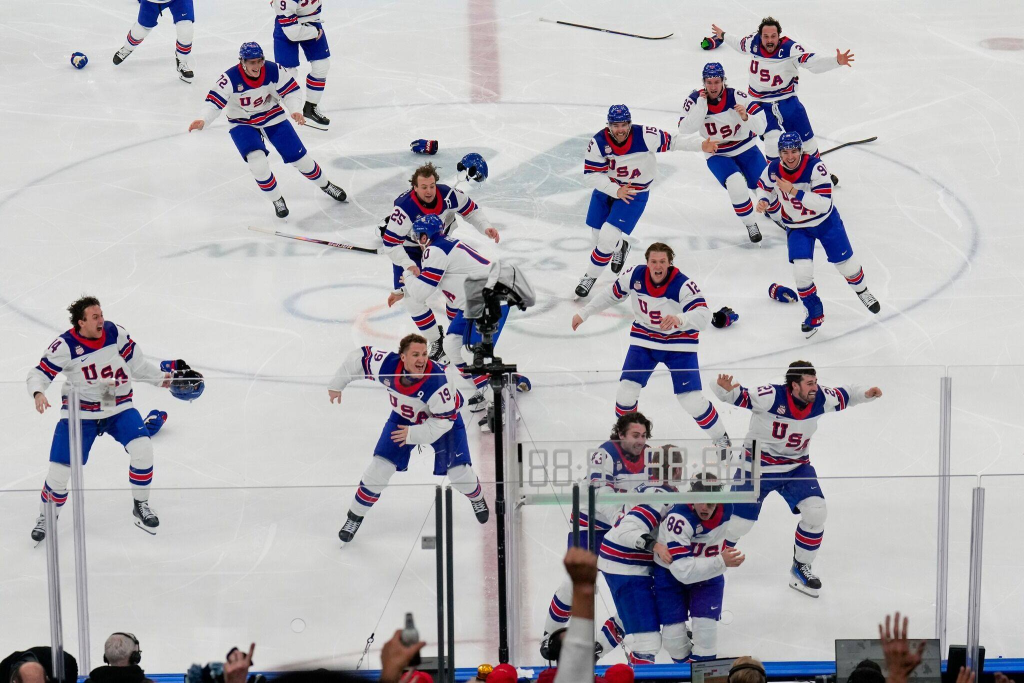
Then came the overtime, and enter Jack Hughes.
Playing in his first Olympics after a career spent establishing himself as one of the most gifted forwards in the NHL with the New Jersey Devils, Hughes had already been the engine of Team USA’s attack, finishing the tournament with four goals and three assists for seven points across six games. But nothing compared to what happened 1 minute and 41 seconds into the 3-on-3 overtime. Hellebuyck started the play from his own crease, the puck moved to defenseman Zach Werenski, and then found Hughes streaking in. With the poise of a player born for exactly this moment, Hughes slipped the puck between Jordan Binnington’s legs, and the gold medal was won.
“It doesn’t matter about the goal,” a gap-toothed and grinning Hughes said afterward, having lost two teeth to a high stick from Sam Bennett earlier in the game. “Just an unbelievable team win. We’re so proud to be American and to win for our country, to win for the USA Hockey brotherhood.” He even managed to joke about his dental situation: “I’m from the best country in the world. We’ve got great dentists there, too.”
For Johnny
What happened next elevated the moment beyond sport entirely.
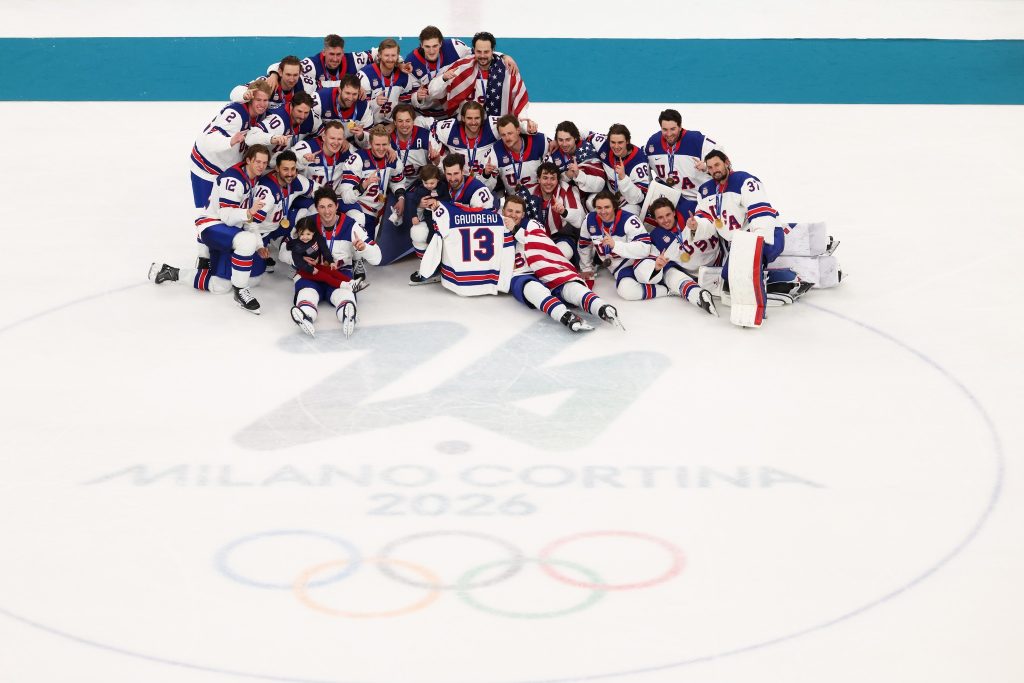
From the first day Team USA arrived in Milan, an extra jersey hung in the locker room. Number 13. The name Gaudreau across the shoulders. Johnny Gaudreau, beloved teammate, gifted playmaker, 743 career points across 763 NHL games, nicknamed “Johnny Hockey” since his days at Boston College where he won the Hobey Baker Award in 2014. A man who, by all accounts, would have been on this very team, who had been training harder than ever in the summer of 2024, pushing himself toward an Olympic dream he never got to chase. On August 29, 2024, the night before his sister’s wedding, Johnny and his younger brother Matthew were struck and killed by an alleged drunk driver while riding their bicycles near their home in Salem County, New Jersey. Johnny was 31. Matthew was 29. The hockey world wept, and has not stopped.
Throughout the entire Milano Cortina tournament, the jersey hung there as a constant. A reminder. A presence. Head coach Mike Sullivan had told Johnny’s father Guy that Johnny likely would have made this team. The players carried that knowledge into every game.
And so when Jack Hughes’ golden goal sent the arena into delirium on Sunday, and when the medal ceremony concluded and the gold gleamed around the necks of two dozen of the best players in the world, Auston Matthews, Matthew Tkachuk, and Zach Werenski took that No. 13 jersey and carried it around the ice as the crowd broke into a thundering “Johnny Hockey” chant. In the stands, Johnny’s parents Guy and Jane, his widow Meredith, and his three children watched through tears.
Then came the moment that broke everyone open completely. Matthew Tkachuk and Zach Werenski went to the boards and lifted two of Johnny’s children onto the ice, little Noa and Johnny Jr., whose second birthday it happened to be that very day, and brought them into the team photo alongside all those gold medalists. Dylan Larkin held Johnny Jr. in his arms. Meredith later said it best: “We wished we were a part of it, so when we got the call to come out, it felt like maybe Johnny did make the team.”
“To have Johnny Jr. and Noa out there,” Dylan Larkin said, voice cracking, “it just felt right.”
Brady Tkachuk, who wore his emotion freely: “We miss him and Matty so dearly. He would have been on this team. He’s touched everybody on that ice.”
Even Larkin laughed through the tears, because that is what Johnny would have wanted: “Ironic on the defensive side, he would’ve never been back there,” Larkin joked, imagining his friend protecting that lead with him in the final minutes.
What It Means
The United States of America now has both the men’s and women’s Olympic hockey gold medals from Milano Cortina 2026, each won in overtime against Canada, each requiring the kind of relentless belief and heart that cannot be coached into a team but only grown through genuine love for one another and for the nation they represent. The women did it with a veteran captain taking a bow on her own terms and a new generation ready to carry the torch. The men did it 46 years to the day after Al Michaels asked if we believed in miracles, and answered the question all over again.
Both golds are extraordinary. But it is the image of two small children in their late father’s hockey rink, surrounded by men with gold medals and wet eyes, that will outlast all the box scores and all the statistics and every overtime goal scored on Italian ice. Johnny Gaudreau made the team after all.