

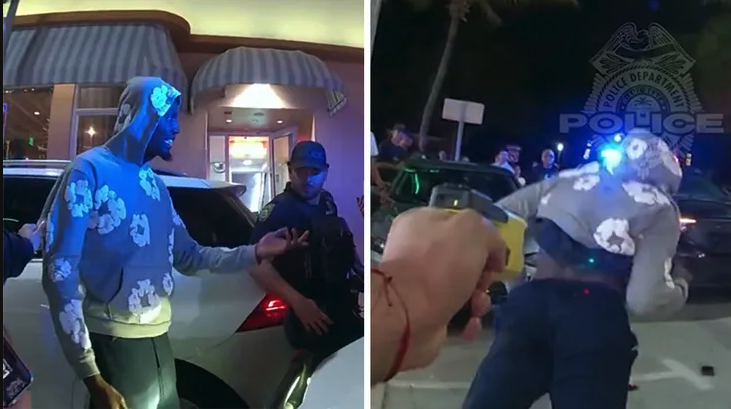
Olympic sprinter Fred Kerley, 29, was arrested on Thursday night in Miami Beach following a confrontation with police that resulted in him being struck, grounded and tased. The incident occurred around 11:22 PM Eastern on January 2nd when Kerley approached officers at an active police scene, expressing concern about his parked car nearby.
The Incident
According to police reports, Kerley approached the perimeter of an unrelated police scene, apparently concerned about his car parked nearby. Officers described Kerley as having an “aggressive demeanor” and alleged that he attempted to force his way through despite requests to go around the area.
The situation escalated when an officer made physical contact with Kerley, who brushed the officer’s hand aside. This led to a physical altercation involving multiple officers attempting to subdue Kerley.
During the struggle, one officer reportedly struck Kerley multiple times, aiming for his head and upper back. Another video shared on social media shows an officer striking Kerley’s torso. The confrontation culminated with an officer using a stun gun on Kerley, causing him to fall to the ground where he was then handcuffed.
Arrest and Charges
Kerley was booked into jail early Friday morning on charges including:
- Battery upon a law enforcement officer (third-degree felony)
- Resisting an officer (misdemeanor)
- Disorderly conduct (misdemeanor)
He was released Friday afternoon following his initial court appearance.
Kerley’s attorney, Yale Sanford, described the body-worn camera footage as “obscene” and expressed concern about the treatment of his client. Miami Beach police spokesperson Christopher Bess stated that the incident was undergoing a standard review, as is protocol for all use-of-force incidents. He added that the officers “responded to the resistance appropriately and professionally”.
Witness Accounts
Bystanders gathered at the scene, with many recording the incident on their phones. Cleo Rahman, identified as Kerley’s girlfriend, was heard repeatedly shouting “stop!” during and after the encounter. As this matter is now subject to legal proceedings, further details will likely emerge as the case progresses through the judicial system.
Additionally, police later added charges of strong-arm robbery and domestic battery by strangulation related to a separate incident from May 2024. The truth in these situations will always come out.
Kerley, who won a bronze medal in the 100-meter event at the 2024 Paris Olympics, was released on his own recognizance for the initial charges. His attorney has called the arrest “a total misunderstanding” and claimed that police used excessive force.
Questions
There are a few aspects of this situation that raise questions or seem off, and they could be worth unpacking:
- Nature of the Confrontation: The report indicates that Kerley approached officers expressing concern about his parked car, which doesn’t sound like the kind of action that would typically escalate into a physical struggle. It suggests that his demeanor may have been aggressive, but that’s not enough to explain how quickly things turned violent. If his concern was genuinely about his car, it seems unusual that he would have become confrontational to the point of pushing a police officer.
- Use of Force: The escalation to a physical struggle with multiple officers involved, including the use of a Taser, seems concerning given that Kerley’s actions were reportedly based on his car being parked near an active police scene. The details here don’t clearly justify such force, and it raises questions about whether police overreacted, as suggested by Kerley’s attorney.
- Additional Charges: The mention of separate charges—strong-arm robbery and domestic battery by strangulation—from an incident months prior is a significant red flag. It’s unusual to see charges from another event suddenly resurfacing in the context of a new, unrelated arrest. The timing and circumstances of these charges could be crucial to understanding the full story. If these charges are unrelated, they may serve to complicate the narrative or shift attention away from the incident in Miami Beach.
- The Attorney’s Statement: Kerley’s attorney calls the arrest “a total misunderstanding” and claims excessive force. While this is to be expected from a defense attorney, it raises doubts about whether the full context is being shared. The use of a Taser, if deemed excessive, could be an important point in this case—especially if Kerley wasn’t initially physically threatening to the officers.
There are several elements that seem to clash with one another. The escalation of events, the significant use of force, and the later addition of unrelated charges all contribute to a sense that this case may be more complex than it initially appears. Non-compliance, overreaction, excessive use of force, added charge overreach to intensify legal advantage or burden all should be evaluated and admonished strictly. Further investigation and clearer details might be needed to understand the full picture.
Perspective
In situations where law enforcement is conducting an investigation or managing an active scene, it is essential to respect the officers’ rights and authority to secure the perimeter. Officers are tasked with ensuring public safety, maintaining order, and preventing any interference with their work. When a perimeter is established, it is for the purpose of preserving evidence, ensuring the safety of those involved, and enabling an effective investigation.
It is important to understand that, while individuals have the right to express concern or ask questions, they must do so in a manner that does not impede law enforcement’s ability to carry out their duties. Approaching officers or entering a secured area without permission can create unnecessary risks and complications, both for the individuals involved and for law enforcement personnel.
Everyone has the right to seek clarification or express concerns, but doing so in a respectful and non-disruptive manner is crucial. Cooperation with police officers during an active scene helps ensure that the investigation can proceed without unnecessary interruptions and that everyone remains safe.