
Whose Story Is It?
When a family’s memory collides with a screenwriter’s pen, the question isn’t just what’s accurate. It’s who gets to decide what a legend was.
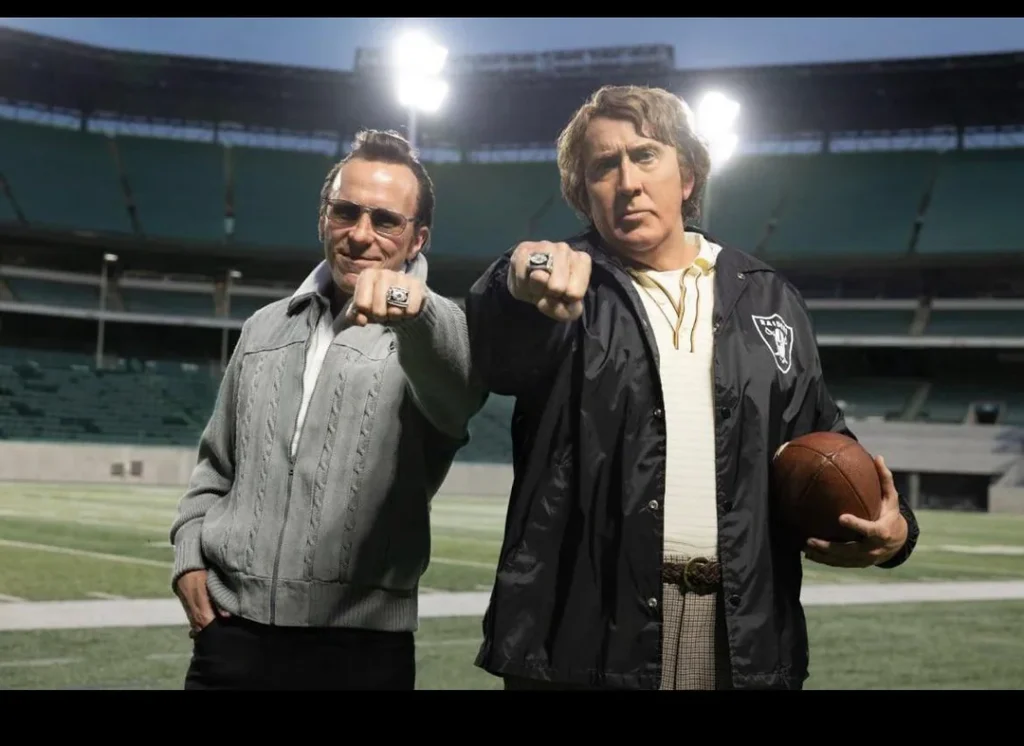
Mark Davis didn’t mince words after watching Prime Video’s Madden. The Las Vegas Raiders owner told USA Today Sports and the Las Vegas Review-Journal that the film left him “hurt,” and he called it “unfair” to turn people who can no longer speak for themselves into caricatures. His father, the late Al Davis, was the target.
Davis was careful about where he aimed. He didn’t fault Christian Bale, who plays Al Davis, or Nicolas Cage, who plays John Madden, for doing what directors asked. His complaint was with the script and the tone. He likened the film to a blend of Pulp Fiction, Vacation, and Saturday Night Live, and he did not mean it as a compliment.
The Scene That Crossed the Line
One moment in particular crystallized his objection. The film shows Al Davis discouraging Madden from visiting Darryl Stingley, the New England Patriots receiver paralyzed by a devastating hit in a 1978 preseason game. Mark Davis says his father would never have said such a thing. By his account, Al Davis spent years quietly supporting injured and struggling players across the league, often without ever seeking credit.
That detail matters because it turns an abstract complaint about “accuracy” into something personal. A son is saying the film attributes to his father the opposite of what he stood for.
For a family, that is hard to shrug off. Real people are layered and contradictory, and they rarely fit a two-hour runtime. When a scene bends a person’s character to raise the drama, it can stop feeling like storytelling and start feeling like a verdict, delivered on someone who can’t appeal it.
The Filmmaker’s Counterargument
The other side deserves a fair hearing. Directors like David O. Russell aren’t building museum exhibits. A biopic is not a documentary, and its first obligation is to hold an audience: compress decades into a single arc, build momentum, and make people care.
Drama runs on conflict, so filmmakers sharpen it. A complicated working relationship between a passionate coach and a fiercely independent owner becomes a collision of personalities. Eccentricity and exaggeration help casual viewers feel the outsized presence that made Madden and Davis famous in the 1970s. Without that heat, the film risks becoming a recitation of facts.
A Familiar Tightrope
None of this is new. Sports films from Moneyball to Air have drawn scrutiny for compressed timelines, composite characters, and invented dialogue written to punch up a scene. The genre has always traded in a bargain: the audience accepts some fiction in exchange for emotional truth.
The trouble starts when the fiction stops serving the truth and starts replacing it. Lean too hard on textbook accuracy and a film goes flat. Lean too hard on caricature and it alienates the people who care most: the die-hard fans, and the families who carry the real person’s memory.
Taking Back the Narrative
Davis is not content to simply object. He has signaled that the experience may push him to produce his own project, one that tells his father’s story on his own terms.
There’s a lesson in that beyond football. Legacy is a kind of stewardship, and those who inherit it can either defend it after the fact or shape it before the story is told. Whether Davis follows through remains to be seen.
Until then, Madden stands as a pointed reminder of how thin the line is in sports cinema between capturing a legend’s spirit and distorting a legacy, and of how much depends on who is holding the pen.