
The Wrong Time to Point Fingers: Jaylen Brown’s Post-Elimination Stream Is a Mirror He Should’ve Looked Into
Here’s the brutal truth that no Twitch stream can spin: the Boston Celtics, a No. 2 seed, former NBA champions, 61-win team, just became the 14th team in NBA history to blow a 3-1 lead. And rather than sit in that uncomfortable silence, Jaylen Brown went live.
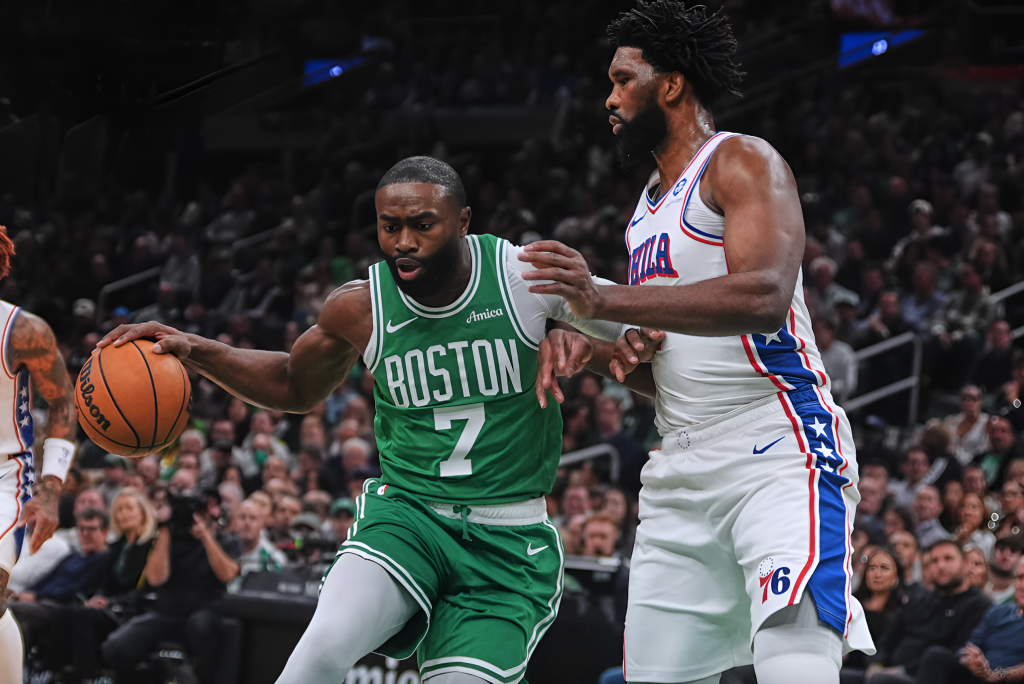
Less than 24 hours after the Celtics’ elimination, Brown took to his Twitch stream and aired his grievances with Joel Embiid and NBA referees. He declared that flopping has ruined the game, pointed at the officiating crew, and suggested there was a coordinated agenda against him. Some of it landed. Most of it missed badly, not because of what he said, but because of when he said it and why it rings hollow.
Let’s be fair to Brown first. He is far from the only player who consistently uses his off-arm to clear out defenders as a driver. George, Brunson, and Shai Gilgeous-Alexander are notorious offenders in that regard. The flopping critique of Embiid isn’t exactly revolutionary either. Brown gave credit to Embiid and his teammates throughout the stream, and acknowledged Embiid as one of the greatest big men the game has ever seen. There’s nuance in there — if you listen past the noise.
And the Embiid flopping conversation? Brown drew a distinction that actually matters: “Drawing fouls is fine. I don’t complain about nobody drawing fouls. Flopping and exaggerating contact is different.” That’s a legitimate line. That’s a reasonable debate worth having in the league.
But the optics? Catastrophic.
In the Celtics’ first-round series against the Sixers, Boston held a 3-1 lead over Philadelphia before losing three straight games. Philadelphia became the first No. 7 seed in the Eastern Conference to beat a No. 2 seed since the first-round format expanded to a best-of-seven series in 2003. That’s not a footnote. That’s the headline. That’s the entire story. And no amount of referee rebuke changes it.
Brown was called for 10 offensive fouls in the first round of the playoffs. His per-game foul rate more than doubled from the regular season. Rather than ask why that happened, whether his game needs adjusting in the postseason, whether his footwork, his off-arm habits, or his decision-making exposed him — Brown pointed outward. Toward Embiid. Toward the refs. Toward an “agenda.”
The Celtics’ season ended in brutal fashion. “It stings, as it should,” Brown said at the podium. “Any time losing, it stings, especially finishing your season like this. But it just wasn’t our year.” That quote, right there, was the right note. It was measured, honest, accountable. The Twitch stream, fired off in the 24 hours that followed, undercut all of it.
The ear-share problem is real. When you’ve just been the centerpiece of one of the most stunning collapses in recent playoff history, the court of public opinion is not where you want to pick a fight with Joel Embiid and the officiating staff. The conversation should be about the Celtics’ implosion — their inability to close, their struggles defending without Tatum, what this roster needs in order to rebuild. Instead, the narrative is now about Brown’s grievances on a Twitch stream. That’s a self-inflicted wound on top of an already painful exit.
What does Boston actually need to address? That’s the question worth lingering on. The Celtics enter a cost-cutting offseason in a unique place, they were already going to need to make deep salary cuts to their roster, but now they have the added variable of a looming season without Tatum. The organizational questions are real, the competitive window is narrowing, and the franchise’s best player just suffered a torn Achilles. That’s the conversation. That’s where the energy should go.
Jaylen Brown is a competitor. His passion is not in question. His points about flopping and inconsistent officiating aren’t without merit. But in the aftermath of a 3-1 collapse, with his team’s future genuinely uncertain, the loudest voice in the room needs to be asking what can we do better, not who else is to blame.
The mirror was right there. He just chose not to look into it.