

Diego Pavia, Vanderbilt’s quarterback, has won a significant legal victory against the NCAA. A federal judge granted Pavia a preliminary injunction, allowing him to play in the 2025 season without his junior college (JUCO) years counting against his NCAA eligibility. This ruling stems from Pavia’s lawsuit challenging the NCAA’s eligibility rules for former JUCO athletes, arguing that they violate antitrust laws. The court’s decision blocks the NCAA from enforcing its bylaws that would preclude Pavia from playing NCAA Division I football in 2025.
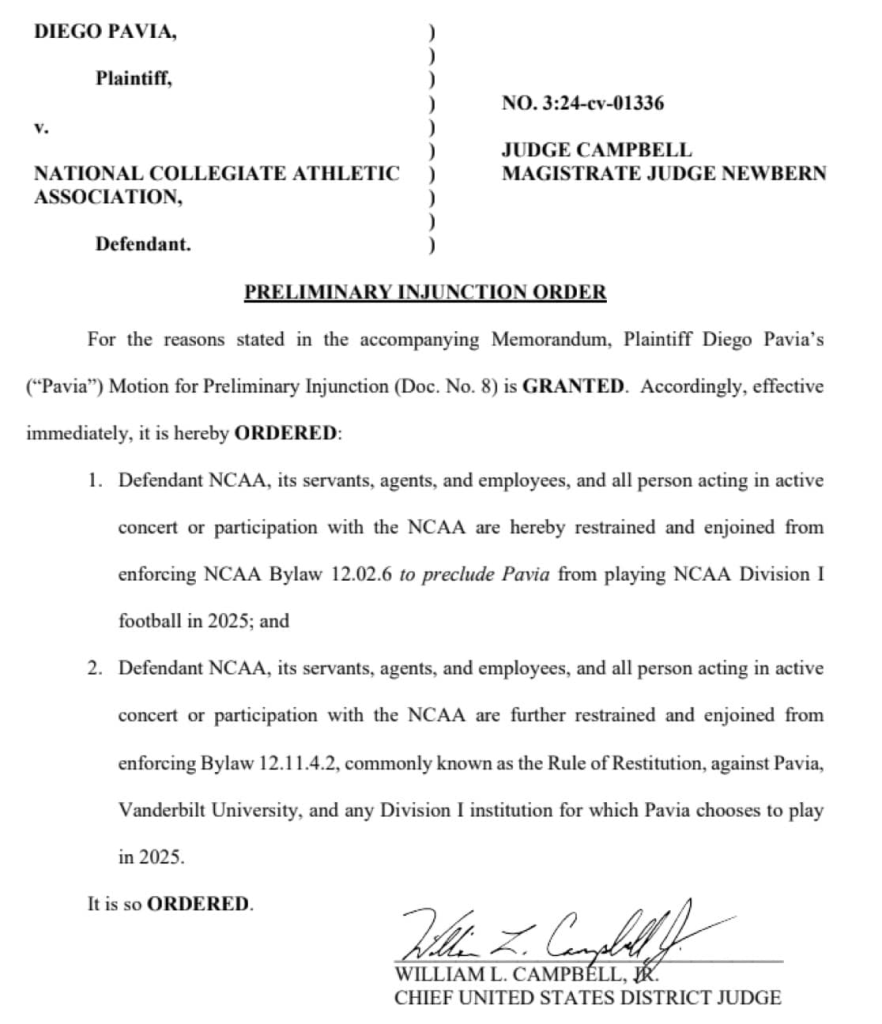
The ruling could have wide-reaching effects on how JUCO transfers are treated in terms of NCAA eligibility. If upheld, it may allow more JUCO athletes to retain eligibility when transferring to NCAA institutions, potentially extending their careers at the Division I level. The decision challenges the NCAA’s current practice of counting JUCO years against an athlete’s eligibility clock, a position Judge Campbell described as inadequate in this case. This ruling adds to a series of legal setbacks for the NCAA, further weakening its ability to enforce eligibility rules and possibly reshaping the landscape of college athletics.
The next legal steps include the possibility of the NCAA appealing the decision, which could delay or alter the outcome. The court will also address the merits of Pavia’s antitrust claims in a future trial, and if successful, the case could extend beyond Pavia to influence eligibility rules for all JUCO athletes. The decision may prompt broader policy changes within the NCAA and could encourage other athletes to challenge similar eligibility restrictions.
The Problem With It All
The legal battle over Diego Pavia’s eligibility—and broader challenges to NCAA eligibility rules for JUCO athletes—could set off a range of counterarguments, especially with the prospect of players potentially playing college sports close to or into their 30s. While Pavia’s case is currently focused on the unfairness of counting JUCO years against eligibility, the implications could continue ongoing concerns about the competitive balance in college sports. Here are some of the major counterarguments and concerns:
1. Creating an Unfair Competitive Advantage for Older Players
One of the most significant counterarguments is that allowing older athletes, potentially in their late 20s or early 30s, to compete against younger players (typically in their teens or early 20s) could create an unfair advantage, particularly in high-contact sports like football. Older players might have more physical maturity, experience, and strategic understanding of the game, making them potentially more dominant on the field.
- Advantage in Physical Development: Athletes who spend extra years developing in JUCOs or other systems may have better physical conditioning, strength, and mental preparation than players who enter Division I directly after high school. This could create an imbalance, especially in sports where size, strength, and experience are crucial factors (e.g., football, basketball).
- Impact on Freshmen and Underclassmen: Freshmen and underclassmen may find themselves outmatched by athletes who have been playing at a higher or more competitive level for several years. This could undermine the development of younger players who are typically expected to take time to adjust to the speed and intensity of Division I sports.
2. Devaluing the Traditional Four-Year College Experience
The NCAA’s current eligibility rules are designed to provide opportunities for athletes to compete in college sports while also obtaining an education. If older players, particularly those with extended JUCO careers, are allowed to retain eligibility, this could alter the dynamics of college sports, potentially undermining the “four-year student-athlete” model that many schools and fans value.
- Extended College Careers: If athletes are allowed to play into their late 20s or 30s, it could fundamentally change the concept of the college athlete, leading to a situation where some players spend more years in college than many students themselves. This could lead to concerns that the system is prioritizing athletic careers over the broader educational goals of the university.
- Displacement of Younger Athletes: This could create an environment where younger athletes, especially those coming in after high school, might struggle to secure playing time. Older, more experienced players could take spots that would otherwise go to younger, less experienced—but still highly talented—players.
3. Potential for “Super-Seniors” and Perpetual Eligibility
There is a concern that this ruling could lead to a situation where athletes continue to play college sports indefinitely, particularly if the NCAA is forced to adjust its eligibility rules for JUCO transfers. If players are allowed to retain their eligibility even after multiple years in JUCO or lower divisions, some could potentially extend their careers well into their 30s.
- Excessive Eligibility: Players might play 5, 6, or even more years in college sports, especially if they have lengthy stints in JUCO programs before transferring. This creates a scenario where athletes who entered college later or needed more time to develop could still be competing at a high level in their 30s.
- Impact on Recruiting: Coaches might prioritize older, more experienced athletes who could contribute immediately rather than recruiting younger athletes who may need more time to develop. This could alter the landscape of college sports recruitment and create a situation where age, rather than potential or academic progress, becomes the defining factor.
4. Financial and Institutional Concerns
The NCAA, schools, and athletic programs might also face financial challenges and institutional concerns if older athletes are allowed to play longer.
- Scholarships and Resources: College programs may have to allocate more resources (scholarships, training, etc.) to support older athletes who stay in the system longer. This could affect the number of scholarships available for incoming students, particularly underclassmen, and could reduce opportunities for younger players to develop.
- Financial Burden on Athletic Departments: Longer careers for older athletes could create a financial burden on athletic departments that already deal with limited resources. Some programs might find themselves funding athletes who no longer contribute to the educational goals of the university, while also supporting a younger generation of athletes.
5. How and When Does It End?
One of the most philosophical and practical counterarguments revolves around the question of when the eligibility process ends and how long it can stretch without fundamentally altering the landscape of college sports. There is a concern that without clear limits, the eligibility rules could spiral into a situation where athletes play much longer than the traditional four years, causing significant disruption.
- The “Endgame” Question: How many years of eligibility should an athlete be allowed, and how should the NCAA define the balance between student-athletes’ educational and athletic pursuits? If players are allowed to play into their late 20s or 30s, where do you draw the line? Would older athletes still be considered “student-athletes” in the traditional sense? And how would this affect the integrity of the college sports system?
- Impact on NCAA and College Sports Integrity: Many critics argue that extending eligibility indefinitely would take college athletics too far from its original purpose—providing a college education while allowing students to compete in sports at a high level. There is a worry that it would create a system where players treat college more as a career opportunity than a part of their educational journey.
The Tension Between Fairness and Competitive Balance
The challenge with allowing JUCO transfers to retain eligibility—especially for an extended period—is finding the right balance between fairness and maintaining a competitive balance. While it’s important to ensure that JUCO athletes aren’t unfairly penalized for their path to Division I sports, there is a valid concern about the consequences of allowing athletes to continue playing well into their 30s. This could not only create an unfair advantage but could also fundamentally change the nature of college sports, making it more about professional athletics than the student-athlete model that the NCAA was originally built upon.
The other side of that argument is this, not everyone has the opportunity to jump straight into Division 1 athletics, whether due to academic challenges or simply not being ready for that level of competition. For many athletes, attending a junior college offers a valuable chance to improve both academically and athletically, giving them the time and resources needed to enhance their grades and refine their skills—ultimately setting them up for a successful transfer to a top-tier program where they can reach their full potential.
Ultimately, as with many legal battles involving the NCAA, this case could end up protracted and spark a broader discussion on how to create a system that is both fair to athletes of all backgrounds while preserving the integrity and balance of college sports. The question of “when does it end?” will likely be central to any policy changes or legal outcomes that result from this case.