
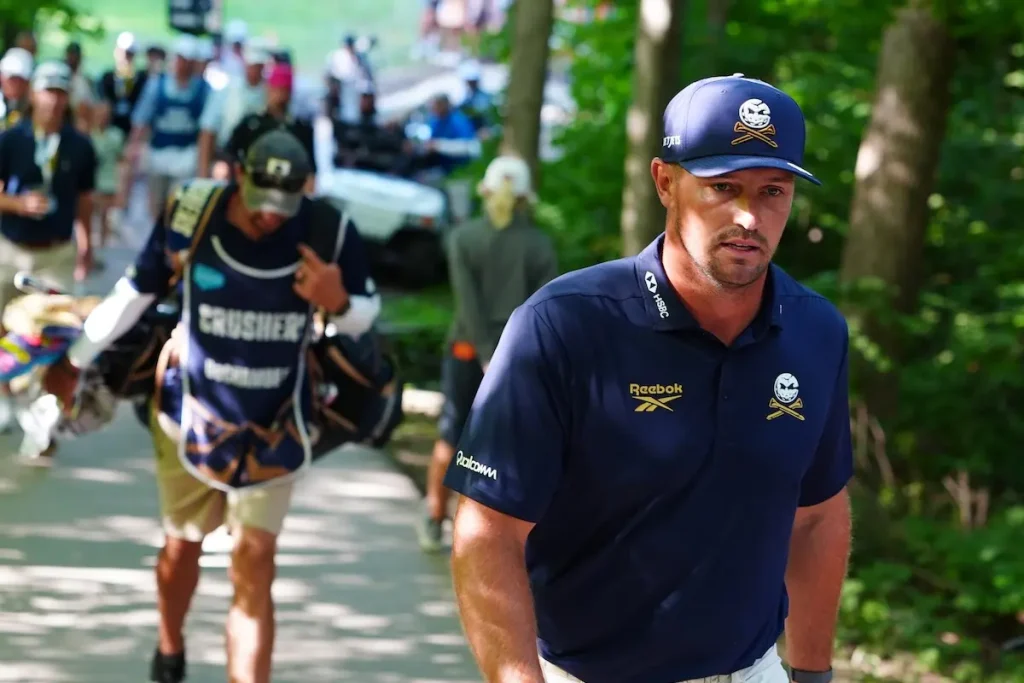
As LIV Golf’s future hinges on an October 25 player deadline, a bigger question emerges: can the sport’s most marketable players build something that outlasts the tours they left?
By Packed House Sports | October 13, 2026
Professional golf’s long contest over who controls the sport has reached a pressure point. LIV Golf, the Saudi-funded breakaway league, is in bankruptcy protection, its biggest names are weighing divergent futures, and the established tours are deciding how much to punish or welcome the players who left.
At stake is a question the sport has avoided answering: when the players who draw the audience decide they no longer need the tours that built the game’s infrastructure, who holds the power?
A league rebuilt around its players
LIV filed for Chapter 11 protection in the United States after Saudi Arabia’s Public Investment Fund said it would stop bankrolling the league beyond the 2026 season, according to reports. The fund had spent more than $5 billion since the league’s launch, helping it sign major champions including Jon Rahm, Bryson DeChambeau and Dustin Johnson.
The league’s proposed successor, dubbed “LIV 2.0,” would be a team-focused circuit in which players are equity owners, according to the Associated Press. LIV chief executive Scott O’Neil has outlined a reduced 2027 schedule of ten events, five team and five individual. BC Partners Credit has announced an initial $4 million commitment toward a targeted $300 million financing package, an investment that still requires court approval.
Players originally faced an October 13 deadline to pledge their support. The league has since extended it to October 25, giving its stars roughly two more weeks to decide.
The stars are not moving as one
The early response suggests the league’s marquee players are far from united. Rahm’s attorney told a bankruptcy court in New Jersey last week that the two-time major champion had reviewed the proposed terms and would not take part in 2027. Where he will play next has not been announced.
DeChambeau, among LIV’s most recognizable figures thanks to a large online following, remains undecided, according to reporting from golf insider Alan Shipnuck. His choice is widely viewed as a barometer for the new league’s viability.
Brooks Koepka took a different path earlier this year. After negotiating the end of his LIV contract, he returned to the PGA Tour under what the AP described as heavy financial stipulations, an exception to the tour’s usual one-year ban for players who last competed on LIV.
The divergence matters. A coalition of stars needs shared goals, and so far these players are making individual calculations about money, rankings and access to the sport’s biggest events.
The established tours push back
The DP World Tour has drawn its own line. After allowing several LIV players to keep membership during 2026 under a conditional arrangement, the tour has signaled that the deal will not carry over, according to reports. Players must choose between committing to the European circuit and playing LIV in 2027.
The stakes extend beyond tournament schedules. DP World Tour membership brings world ranking points, which help players qualify for the major championships, and it underpins Ryder Cup eligibility for Europeans. Losing it, as one report put it, would remove a player’s route into the team.
The PGA Tour, led by chief executive Brian Rolapp, has taken a similarly firm approach, offering returns on restrictive terms. Those conditions raise a question for the tours: whether protecting a business model and the loyalty of players who stayed is worth keeping some of the sport’s top draws on the sidelines.
Could the players go it alone?
The idea is easy to state. A group of elite golfers could stage independent events, negotiate directly with broadcasters and sponsors, and keep a larger share of the revenue they generate. Many already operate as media businesses, with sponsorships and social audiences that reach well beyond traditional golf viewers. LIV 2.0’s equity model is a sign that player ownership is already on the table.
But the obstacles are substantial.
Capital. LIV’s rise was powered by state-backed money. A players’ league would need a financial partner, and that partner would expect influence.
Pathways. The major championships, ranking points and Ryder Cup eligibility are controlled by bodies outside any breakaway group.
Operations. Tours provide courses, officials, schedules, media production and sponsor relationships. Replicating that infrastructure is expensive, and it requires full fields, not just stars.
Cohesion. Collective leverage depends on collective commitment, which the current split among LIV’s top players makes uncertain.
What comes next
A fully independent players’ circuit appears unlikely in the near term. A more plausible outcome is a negotiated settlement in which players gain greater ownership and a stronger voice in scheduling and media rights, while the established tours retain the infrastructure and pathways that give the sport its structure.
What the past four years have made clear is that neither side can claim the sport alone. The tours need the stars who attract audiences and sponsors. The stars need the competition, rankings and championships that give their popularity meaning. The October 25 deadline will show which stars choose which path, and how much leverage each side really holds.
Note: Reporting on LIV’s bankruptcy timeline and player commitments is evolving, and details may change before publication.