
The SEC’s Nuclear Option
Kirby Smart and Georgia’s president want out of the NCAA’s circus. Here’s how that might actually happen, and why it’s harder than it sounds.
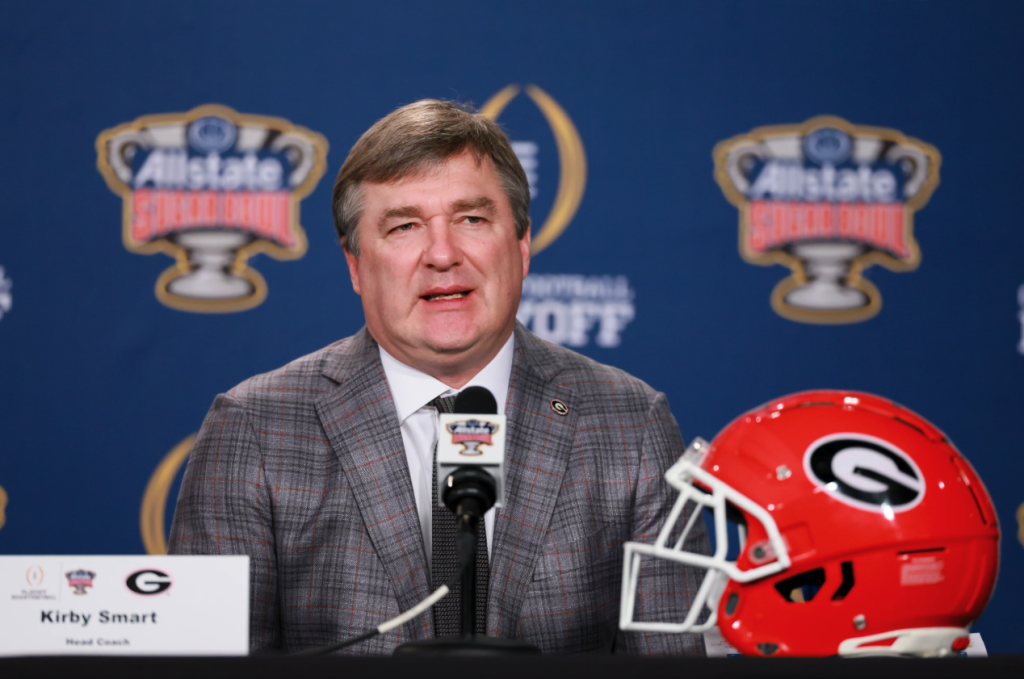
College football has never been short on big talk. But when a head coach with two national championships and a university president speak in the same voice, it is worth taking seriously. At the SEC spring meetings in Destin, Florida, Georgia’s Kirby Smart laid out a vision that is either the sport’s boldest restructuring idea in a century or its most elaborate bluff.
The message was simple: if the rest of college football cannot agree on rules everyone will follow, the SEC will write its own.
“If we can’t find rules that everybody plays by, then we should play our own. I’m not afraid of that.”
Kirby Smart, Georgia Head CoachSmart was not freelancing. Georgia president Jere Morehead told The Athletic that he is prepared to vote on creating an entirely independent SEC governance structure if federal NIL legislation does not materialize. He acknowledged it would take five or more years. But he made clear he likes the idea and SEC commissioner Greg Sankey is, at minimum, listening.
So what would it actually look like? And how hard would it really be?
Building a Conference-State
The core of a breakaway is simpler than it sounds, because the SEC already functions as a semi-sovereign entity. It negotiates its own television deals, worth hundreds of millions annually per member school under existing ESPN and ABC contracts. It runs its own championship events. It has staff, legal infrastructure, and financial reserves that dwarf most mid-major conferences combined.
A breakaway would formalize what is already partially true: the SEC would establish its own governing body, something like an SEC Athletic Association, complete with its own eligibility rules, NIL spending frameworks, transfer regulations, and enforcement mechanisms. Member schools would sign a binding charter, effectively trading NCAA membership for SEC citizenship on the matters that have frustrated them most.
The College Football Playoff relationship would require its own renegotiation. The SEC could demand revised terms for continued participation, or walk away and create a competing postseason structure, either standalone or in partnership with the Big Ten and select others.
The NIL question is where this structure becomes genuinely appealing to the SEC. Right now the NCAA’s attempts to regulate name, image, and likeness deals are being strangled in litigation, most recently through the landmark House v. NCAA settlement that opened the door to direct revenue sharing. An independent SEC could set hard, enforceable spending parameters without the antitrust exposure that has handcuffed the NCAA at every turn. Courts have been far more tolerant of collective bargaining-style rules within a defined membership than top-down mandates from a national body with no actual authority over its members.
Smart’s frustration is not with players making money. He said so plainly. The concern is the absence of any level floor, a situation where one program can spend $30 million on NIL while another spends $8 million, and both are supposedly playing the same game with the same recruits. A closed-loop SEC governing structure could set a salary cap in all but name.
Why It Takes Five Years (At Least)
Morehead’s five-year timeline is not pessimism. It is a realistic accounting of the legal and financial knots that would need untangling before any breakaway becomes real.
The most immediate complication is March Madness. NCAA tournament revenue is distributed to conferences and member schools, and it remains a significant check that every SEC school cashes every spring. Exiting the NCAA entirely means walking away from that pipeline. A partial break, covering football governance only while retaining NCAA membership for other sports, is the more likely architecture, at least initially. The NFL has structured professional football entirely outside any wider governing body for decades; that is the template.
Title IX compliance is a secondary but real concern. The federal law’s enforcement has been administered partly through NCAA frameworks. Schools would need to demonstrate independent compliance mechanisms to satisfy the Department of Education, adding regulatory overhead without any obvious benefit.
“I think our fanbase is strong across the country. Imagine if that had been for the national championship?”
Jere Morehead, University of Georgia PresidentThen there is the political dimension. Congressional intervention on NIL, which both Smart and Morehead say they would prefer, could render the whole conversation unnecessary. If federal legislation establishes a national framework with actual enforcement teeth, the SEC’s grievances largely disappear. The breakaway talk may be less a genuine plan than a pressure campaign aimed at Capitol Hill, a way of telling legislators that the conference is serious enough about its frustrations to consider the nuclear option.
And yet. The longer Congress waits, the more the pressure builds. The House settlement is already requiring schools to share up to $20 million annually with athletes directly. With that door opened, the appetite for a structure that controls those costs collectively will only grow. The SEC is not bluffing about the problem, even if the solution is still years away from a vote.
A 16-team SEC playoff, broadcast on a conference-owned network with national reach, would generate enormous ratings. Morehead pointed to the Georgia-Alabama SEC championship as proof. The market exists. The infrastructure does not yet.
Smart has attended these spring meetings eleven times. He has heard “we can’t do that because of litigation” enough times that the phrase now visibly irritates him. Whether the SEC breaks away entirely, negotiates a new compact with the NCAA, or pressures Congress into action, the era of passive frustration appears to be over.
One of the most powerful conference in college football has decided it is tired of playing by rules it did not write and cannot enforce. The question is no longer whether that sentiment is real. It is whether the will to act on it outlasts the lawyers.