

The Fall
For two of college football’s most storied programs, the latest AP Poll delivered a sobering reality check. Both Penn State and Texas—teams that began the season with lofty expectations and playoff aspirations—have tumbled out of the Top 25 for the first time since 2023. It marks not only a symbolic fall from grace but also a critical juncture in each program’s trajectory as the regular season enters its final third.
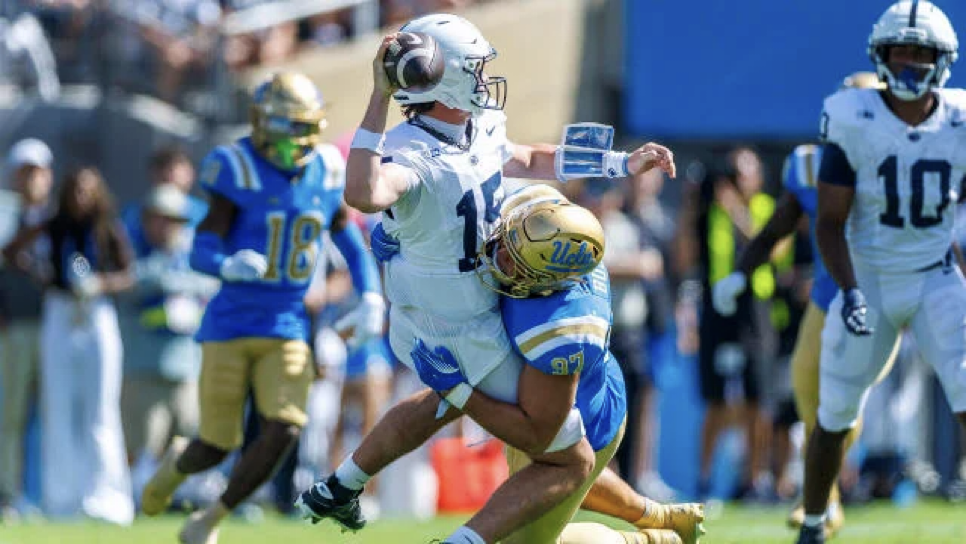
Penn State’s slide was punctuated by a shocking 27-11 home loss to previously winless UCLA, one of the most stunning upsets of the season and the Nittany Lions’ third consecutive defeat. The loss dropped Penn State to 4-3 overall and just 1-3 in Big Ten play. The Nittany Lions’ struggles on both sides of the ball have exposed deeper issues with consistency, offensive identity, and defensive discipline—particularly troubling for a program that entered the year ranked No. 8 and viewed itself as a legitimate College Football Playoff contender.
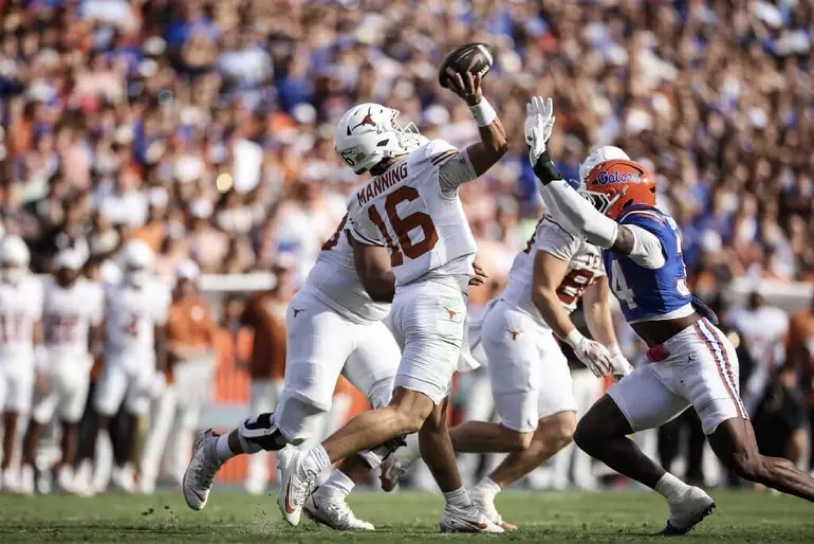
Similarly, Texas faltered in its high-profile matchup against Florida, suffering a 33-20 defeat in Gainesville that snapped a six-game winning streak against SEC East opponents. The Longhorns’ offense sputtered, managing just 289 total yards—their lowest output since 2023—while their defense failed to contain explosive plays, allowing the Gators to convert 9 of 15 third downs. For a team that entered 2025 ranked No. 3 with championship ambitions and fresh off its move to the SEC, the drop in performance has been as concerning as it has been swift. At 5-2 overall and 2-2 in conference play, the Longhorns now face an uphill battle to reach the SEC Championship Game.
Quarterbacks Under the Microscope
Penn State – Drew Allar: Talent Meets Turbulence
Drew Allar entered the season as a potential Heisman dark horse and undeniable arm talent, projected by many analysts as a future first-round NFL draft pick. But his performance has fallen short of what was promised. Through seven games, Allar has completed just 58.3% of his passes with 11 touchdowns against 8 interceptions—a troubling ratio that reflects deteriorating decision-making and accuracy, particularly in big-game moments. In the UCLA loss alone, he threw three interceptions and was sacked five times.
While Allar has shown flashes of leadership and grit—extending plays under pressure with his mobility and refusing to quit even as the pocket collapsed—his production has been weighed down by an offensive line that ranks 89th nationally in sacks allowed and a receiving corps that lacks rhythm following the departure of two starting wideouts to the transfer portal. The broader issue may be schematic: Penn State’s pro-style system appears too rigid for a quarterback still developing comfort and timing in year two as a starter. Offensive coordinator Andy Kotelnicki’s complex progressions demand precision that Allar hasn’t consistently demonstrated under duress.
Texas – Arch Manning: Royalty Under Siege
Few players in college football face the scrutiny that Arch Manning does. The nephew of Peyton and Eli Manning and grandson of Archie, he’s learning under a microscope—and the lessons have been harsh. Manning’s arm talent is unquestioned; his 6’4″ frame, quick release, and natural touch have drawn comparisons to his Hall of Fame uncles. But his timing and decision-making have wavered in his first season as the full-time starter after backing up Quinn Ewers.
Manning has completed 62.1% of his passes with 14 touchdowns and 7 interceptions, but those numbers mask concerning trends. He’s forced throws into tight windows, misread coverages in crucial situations, and at times appeared out of sync with his playmakers—particularly in the red zone, where Texas ranks just 67th nationally in scoring efficiency. In the Florida loss, Manning was 19-of-35 for just 198 yards with no touchdowns and two costly interceptions, including a pick-six that shifted momentum in the second quarter.
Texas head coach Steve Sarkisian has defended his young quarterback, preaching patience and perspective while noting that Manning is “still processing the speed of SEC defenses.” Yet the pressure is unmistakable. Critics argue that if the offense’s rhythm depends so heavily on perfect timing and anticipation—hallmarks of Sarkisian’s scheme dating back to his Alabama coordinator days—the system must adapt to the quarterback’s growth curve, not the other way around. The offensive line’s struggles (14 sacks allowed in the last three games) have only compounded Manning’s growing pains.
Coaching and Scheme: Who’s Underperforming?
Penn State – Leadership and Clarity in Question
James Franklin and his staff face legitimate questions about offensive direction and game management as the Nittany Lions slide toward their worst season since 2020. Now in his 11th year at Penn State with a 100-52 overall record but just 3-13 against top-10 opponents, Franklin’s inability to win elite-level matchups has become an unavoidable narrative.
The Nittany Lions’ approach often looks predictable and conservative, particularly in high-stakes situations. Against UCLA, Penn State ran the ball on first down on 18 of 22 possessions, making them alarmingly easy to defend. Coordinators have been slow to adjust midgame, and the lack of offensive creativity—few play-action concepts, minimal pre-snap motion, and an over-reliance on outside zone runs—has magnified execution issues.
The defense—long a hallmark of Franklin’s teams and led by veteran coordinator Manny Diaz—has also lost its edge, ranking 47th nationally in scoring defense after finishing in the top 15 each of the previous three seasons. The unit is missing key tackles (23 missed against UCLA alone), showing lapses in communication particularly in zone coverage, and struggling to generate pressure without blitzing following the season-ending injury to defensive end Tony Rojas. This all points to a deeper problem: a team uncertain of its identity when adversity hits.
Texas – Expectations vs. Execution
Texas’ challenge is as psychological as it is tactical. Steve Sarkisian’s program was burdened by immense preseason expectations—ESPN’s FPI gave the Longhorns the second-best odds to reach the College Football Playoff, and some analysts called them national title contenders in their SEC debut season. But when the offense misfired early and the defense allowed explosive plays, the gap between hype and performance widened quickly.
Sarkisian’s system remains intricate and timing-based, built on quick-game concepts, RPOs, and precisely timed intermediate routes that exploit leverage advantages. But it can bog down when the quarterback’s rhythm falters or the run game stalls—and both have occurred. Texas is averaging just 3.7 yards per carry over the last three games, well below the 4.5-yard threshold Sarkisian has identified as necessary for his offense to function optimally.
The Longhorns have lost their offensive balance and, with it, their confidence. Drops by receivers (nine in the last two games), penalties at critical moments (Texas ranks 98th nationally in penalty yards), and an inability to sustain drives have created a snowball effect. Defensively, coordinator Pete Kwiatkowski’s unit has struggled against up-tempo offenses, allowing 6.2 yards per play to Florida—well above the 5.1 season average that earned Texas a top-20 defensive ranking through five games.
Where They Go from Here: Paths to Redemption
Both programs face a crossroads that demands clarity, simplification, and renewed purpose. With five regular-season games remaining for each team, the margin for error has evaporated.
Penn State: Simplify and Stabilize
For Penn State, the path forward begins with trimming schematic excess and leaning into Drew Allar’s strengths—quicker reads, simplified progressions, and a steady commitment to the run game behind improved blocking schemes that emphasize gap concepts rather than the zone runs that have been consistently blown up at the line of scrimmage.
Running back Kaytron Allen, who’s averaging 5.1 yards per carry and has shown excellent balance and vision, should anchor the offense with 20-25 touches per game. The coaching staff must also reevaluate defensive adjustments in the wake of Tony Rojas’ injury, potentially shifting to more four-man rushes and trusting the secondary to win in coverage rather than leaving young linebackers exposed in space.
Most critically, Penn State must reestablish accountability and cohesion in the locker room. Reports have emerged of fractured communication between offensive players and coaches, and when trust breaks down internally, confidence unravels externally. The Nittany Lions’ challenge isn’t talent—it’s trust, identity, and execution under pressure. Franklin’s ability to unify his team and restore belief will determine whether Penn State salvages bowl eligibility and recruiting momentum or spirals toward a devastating finish.
The upcoming schedule offers opportunity: three of Penn State’s next four opponents have losing records. A string of convincing wins could rebuild confidence, but the damage to the program’s national reputation may already be done.
Texas: Restore Rhythm and Resilience
For Texas, the reset starts with rhythm. Getting Arch Manning comfortable through tempo, spacing, and simplified reads—leaning on quick screens, designed rollouts, and play-action concepts that minimize processing time—can reignite the offense’s flow. Manning has shown he can be efficient when the pocket is clean and his first read is open; Sarkisian must manufacture those situations more consistently.
The Longhorns must also restore balance. A credible run game that keeps defenses honest—targeting 150+ rushing yards per game—will allow the passing attack to open naturally and take pressure off Manning’s shoulders. Running back CJ Baxter, who’s averaging 4.8 yards per carry, needs to be featured more prominently in the game plan.
Mental resilience is key: Sarkisian and his staff need to shape composure as actively as they design plays. The Florida loss revealed a team that panicked when things went wrong, committing drive-killing penalties and abandoning the run game prematurely. A strong, statement win against a ranked opponent—Texas faces No. 12 Oklahoma State in two weeks—could shift momentum and restore belief, but the foundation has to come first: discipline, physicality, and conviction.
Texas still controls its own destiny in the SEC race if it can win out, but the psychological scars from this slide may linger. Sarkisian must prove he can rebuild confidence without overcorrecting or losing sight of his offensive philosophy.
Both teams have the personnel to rebound; now it’s about who finds stability first and turns correction into momentum.
The Bigger Picture
Falling out of the Top 25 is more than a numerical setback—it’s a moment of truth that will define how these programs and coaches are remembered in 2025. Both Penn State and Texas have the talent and infrastructure to recover, but their rebound will depend on honest self-evaluation, schematic adjustment, and leadership that steadies the storm rather than reacts to it.
For Franklin, the pressure is mounting. Another disappointing season could intensify calls for change from a fan base that’s grown weary of “good but not great” results. For Sarkisian, this represents his most significant test since arriving in Austin—proving he can develop a young quarterback while maintaining championship standards.
The next few weeks won’t just shape their seasons—they’ll reveal what kind of programs they truly are.
The Lessons
The collapse of both programs reveals several hard truths about the modern college football landscape:
Pedigree Doesn’t Protect You – Reputation and preseason rankings mean little once the games begin. Even elite programs with blue-chip rosters and elite recruiting classes must earn their place each week. In an era of expanded playoffs and heightened parity, there are no guaranteed wins.
Depth and Adaptability Are Essential – Injuries, turnovers, and unexpected challenges expose teams without resilience in personnel or game planning. The transfer portal and NIL era have made it harder to maintain elite depth, and coaching staffs must be prepared to adjust schemes to fit available talent rather than forcing players into systems that don’t suit them.
Momentum Is Everything – Once doubt creeps into the locker room, it can derail even the most talented rosters. Sustained success demands mental toughness and leadership—qualities that can’t be measured in recruiting rankings but are just as important as physical tools. In both cases, the difference between championship contender and unranked team was less about talent and more about belief, trust, and composure under adversity.
The 2025 season has reminded us that in college football, nothing is guaranteed. Championships are built on consistency, resilience, and the ability to weather storms—not just expectations and talent alone.
UPDATE: James Franklin was fired by Penn State on October 12, 2025.