

Week 1 of the NFL season offered a fascinating glimpse into how quarterbacks adapt to new systems and environments. While the sample size remains small, several signal-callers showed encouraging signs in their debuts with new teams. Here’s a deeper look at six quarterbacks who made solid first impressions and what their performances might indicate for the season ahead.
Geno Smith (Raiders): The Perfect Marriage of Risk and Reward
The most eye-catching debut belonged to Geno Smith in Las Vegas, where his partnership with offensive coordinator Chip Kelly produced fireworks against New England. Smith completed 24-of-34 passes for 362 yards, leading the Raiders to first in the NFL in explosive pass rate at 26.3%.
What made Smith’s performance particularly impressive was how it showcased his fearless approach to downfield passing. The Patriots blitzed Smith on 47.4% of his dropbacks, yet he consistently found ways to turn pressure into explosive gains rather than conservative checkdowns. His ability to deliver precise throws on deep-breaking routes – including connections to Brock Bowers, Jakobi Meyers and Tre Tucker – demonstrated the kind of aggressive playmaking that Kelly’s system demands.
The concerning element? This high-risk approach comes with inevitable downsides. Smith absorbed four sacks and threw an interception while operating behind an offensive line that may struggle against more disciplined pass rushes. Week 2’s matchup against the Chargers’ coverage-heavy defense will provide a better litmus test of this offensive philosophy’s sustainability.
Aaron Rodgers (Steelers): Veteran Adaptability at 41
Perhaps the most intriguing storyline was watching Aaron Rodgers embrace Arthur Smith’s system in Pittsburgh. Rodgers executed nine dropbacks of under center play-action, nearly matching his single-game best from the past five seasons – a significant departure from his preferred shotgun-heavy approach in Green Bay and New York.
The adaptation paid dividends early. Rodgers delivered his signature deep ball to Calvin Austin III while also working effectively within the structure of Smith’s motion-heavy offense. However, the sustainability question looms large. Seven of Rodgers’ eight explosive throws resulted from coverage busts or missed tackles rather than precision passing, suggesting the Jets’ defensive breakdowns may have inflated his numbers.
At 41, Rodgers showed he can still be an effective point guard in a well-designed system, but his limited pocket mobility remains a significant constraint. The Steelers’ success may depend on how consistently their running game and defense can create favorable game scripts.
Justin Fields (Jets): System Fit Finally Realized
Justin Fields’ debut with the Jets represented the clearest case of a quarterback finding the right system match. After struggling with offensive sync and decision-making in Chicago and Pittsburgh, Fields looked like a different player in Tanner Engstrand’s offense.
The key was protection from his own worst tendencies. Fields had taken sacks on 10.9% of dropbacks during his Chicago tenure – the highest rate in the league – but the Jets built their gameplan around avoiding those situations. New York called runs on 58.1% of their plays, creating manageable third-down distances and keeping Fields out of obvious passing situations where his hesitation becomes problematic.
More importantly, the Jets gave Fields designed runs and intermediate routes that played to his strengths. He averaged only 4.6 yards needed on third down conversions – the shortest in his career – and successfully converted three of six attempts. The system didn’t just hide Fields’ weaknesses; it actively showcased his mobility and arm strength in favorable contexts.
The cautionary note remains that this ultra-conservative approach may limit the offense’s ceiling in close games, but it represents a promising foundation for development.
Daniel Jones (Colts): Steady Management in Transition
Daniel Jones’ Indianapolis debut was less spectacular but potentially more sustainable than some of his flashier counterparts. While the Dolphins’ defensive breakdowns certainly helped, Jones demonstrated the kind of steady decision-making that Shane Steichen’s system requires.
Jones completed passes with a 65% success rate when not facing additional rushers and avoided major mistakes with no interceptions and just one sack. His quick release on outlet passes and ability to find first reads efficiently suggested he’s already comfortable within Steichen’s framework.
The real test comes against more competent defenses. Jones essentially played point guard against a Dolphins secondary that made fundamental errors, but his quick processing and willingness to take what the defense gave him bodes well for consistency. Next week’s matchup against Denver’s defense will no doubt provide a much sterner evaluation.
Cam Ward (Titans): Poise Beyond the Numbers
The most misleading debut performance belonged to rookie Cam Ward, whose stat sheet looked disastrous but whose film told a different story. Ward’s 17.7% dropback success rate ranked 1,101st out of 1,105 quarterback games since 2023, yet observers came away encouraged.
The context matters enormously. Ward faced an elite Denver defense while dealing with drops from Calvin Ridley and near-misses that could have changed the narrative. More importantly, he showed “preposterous poise reminiscent of a veteran, let alone that he is a rookie” while making multiple plays against pressure with anticipation throws.
Ward’s rookie mistakes are correctable – consecutive fourth-quarter sacks that knocked Tennessee out of field goal range, missing an open receiver in the red zone due to early scramble mode activation. But his instinctive passing ability and pocket presence suggest the raw materials for development are firmly in place.
J.J. McCarthy (Vikings): From Woes To Grit
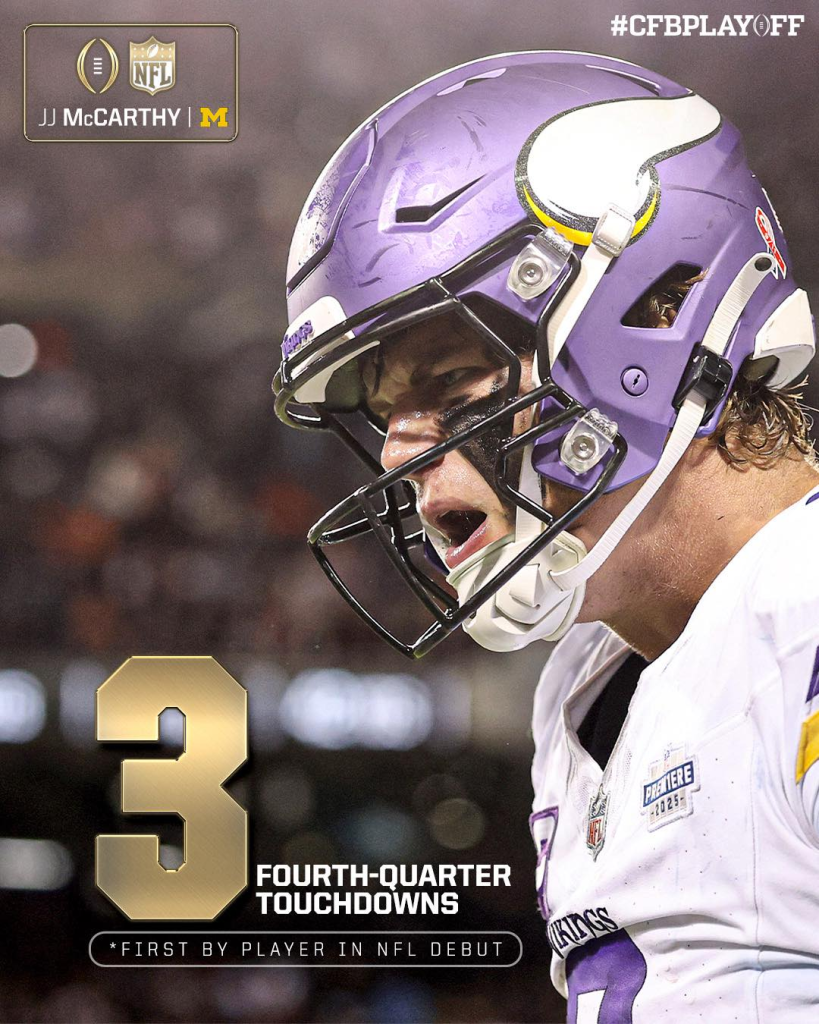
J.J. McCarthy had a challenging start in his NFL debut for the Minnesota Vikings, struggling through the first three quarters and even throwing an interception returned for a touchdown. Despite this rocky beginning, McCarthy displayed remarkable poise and resilience, particularly in the fourth quarter where he orchestrated a 21-point surge to lead the Vikings to a 27-24 comeback win over the Chicago Bears. He threw two touchdown passes and ran for another during this crucial period, showcasing his ability to perform under pressure and lead scoring drives when it mattered most.
McCarthy completed 13 of 20 passes for 143 yards and accounted for three total touchdowns in his first meaningful NFL game since overcoming a knee injury that sidelined him during his rookie year. His coach, Kevin O’Connell, notably expressed confidence in McCarthy at halftime, which seemed to empower the quarterback and fuel his late-game heroics. McCarthy’s ability to bounce back from a sluggish start and a pick-six, coupled with his calm leadership and quick decision-making in the final quarter, highlighted why the Vikings entrusted him as their starting quarterback despite the initial doubts.
Beyond his passing, McCarthy’s 14-yard touchdown run in the fourth quarter that helped seal the game was pivotal, demonstrating his dual-threat capability. His comeback performance contrasted sharply with that of Chicago’s Caleb Williams, whose early success faded as the game progressed. McCarthy’s display of perseverance, leadership, and clutch execution in the final quarter was instrumental in the Vikings’ victory, offering a subdued but build-worthy start to his NFL career.
Looking Forward
These six debuts illustrate different paths to early success in new systems. Smith who embraced controlled chaos, Rodgers adapted his game to new constraints, Fields found protection from his weaknesses and used a quicker release, Jones managed efficiently, while Ward and McCarthy showed flashes despite difficult circumstances.
The common thread? Each quarterback either found a system that maximized their strengths or demonstrated the adaptability to work within their new environment’s constraints. Week 2 will begin to separate sustainable approaches from favorable matchups, but these early returns suggest reason for optimism in each situation.
The real test lies ahead as opposing defenses adjust and the margin for error shrinks. But for now, six quarterbacks have given their new teams reason to believe the change of scenery was exactly what both parties needed.