
When Mythology Meets Reality on the Gridiron
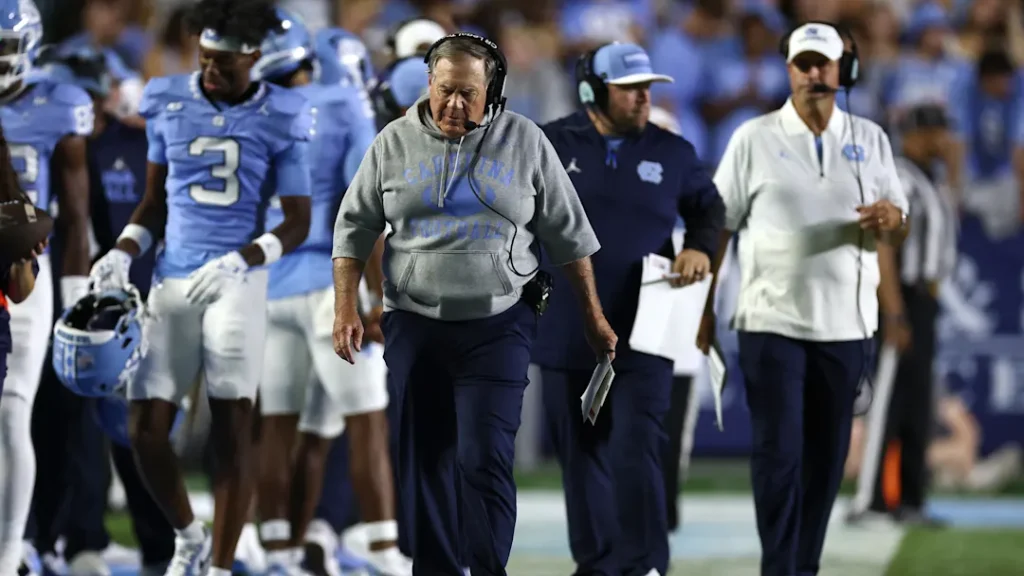
The mythology of Bill Belichick arrived in Chapel Hill with all the fanfare befitting a conquering hero. Celebrity attendees, ESPN primetime lights, and the intoxicating promise that one of football’s most decorated minds would somehow transform our beloved but perennially disappointing Tar Heels into contenders. Reality, as it often does when expectations soar beyond reasonable boundaries, delivered a brutal correction course.
North Carolina suffered a crushing 48-14 home loss to TCU in Bill Belichick’s first game as the Tar Heels’ head coach on Monday night at Kenan Stadium. But the final score, devastating as it appears, tells only part of this cautionary tale about the hubris of assuming that NFL excellence automatically translates to collegiate success.
The Substance-Free Zone: Defense and Press Conferences
Only the UNC defense had less substance than Bill Belichick’s postgame presser. “Did we expect anything less from the Tar Heels head coach”, one reporter asked? Perhaps is my answer.
The parallels between UNC’s defensive performance and Belichick’s characteristic post-game stonewalling were uncomfortably apt. While everyone hoped that Belichick would provide some type of substance with his responses, the long-time head coach did what he normally does: gave us absolutely nothing. His responses were predictably hollow, the same generic non-answers that frustrated NFL media for decades but somehow seemed especially jarring in the aftermath of such a comprehensive failure.
Belichick’s postgame press conference was in the lobby of the UNC football building, with the podium framed by clusters of balloons that were jarringly at odds with the dismal mood. “We’re going to go back to work and get better,” Belichick mumbled. The visual metaphor was perfect: celebratory decorations surrounding empty platitudes, much like the entire evening’s proceedings.
The Anatomy of Defensive Collapse
The Tar Heels’ defense didn’t merely struggle—it evaporated under pressure like morning dew under the Carolina sun. TCU’s offensive execution wasn’t particularly innovative or complex; it was simply competent against a unit that appeared fundamentally unprepared for the speed and physicality of major college football.
Bud Clark had a first-half pick-six and Kevorian Barnes had a 75-yard touchdown run on the first second-half snap to help TCU spoil Bill Belichick’s college coaching debut by rolling past North Carolina 48-14 on Monday night. These weren’t fluky plays, they were symptomatic of deeper structural failures. The passing success was indicative of a defensive back half that couldn’t communicate effectively. The pick-six revealed a TCU secondary that easily baited UNC and jumped routes effectively, while the 75-yard touchdown run on the opening play of the second half suggested a defensive interior that had learned nothing during halftime adjustments.
The False Dawn of Early Success
The Tar Heels dominated early on, jumping out to a lead, but quickly lost their footing and couldn’t regain it. This early success may have been the cruelest aspect of the evening. For a brief moment, the mythology seemed to be taking hold—perhaps Belichick’s preparation and tactical acumen would indeed translate seamlessly to the college game.
But that early lead served only to highlight the team’s fundamental lack of resilience. When adversity struck, when TCU made their inevitable adjustments and began exploiting UNC’s weaknesses, the Tar Heels folded with the kind of comprehensive collapse that suggests deeper cultural and preparational issues than can be solved by switching coaching philosophies overnight.
The Expectations Trap
The intellectual dishonesty surrounding Belichick’s hire becomes most apparent when examining the expectations placed upon this debut. After a weekend full of surprises, Bill Belichick’s team failed to show up for a Monday night clash against TCU. But was this truly Belichick’s team, or was it a collection of players recruited for an entirely different system, suddenly expected to execute concepts foreign to their development?
The notion that a coach—even one of Belichick’s caliber—could fundamentally transform a program’s culture, preparation methods, and on-field execution in a single offseason represents a profound misunderstanding of how institutional change occurs in collegiate athletics. NFL coaching success relies heavily on veteran players who understand professional standards and can self-regulate. College coaching requires building those standards from scratch with 18-22 year-olds who are still developing both physically and mentally.
The Systemic Failures Beyond Individual Performance
What made this loss particularly damning wasn’t just the margin of defeat, but the manner in which it unfolded. This wasn’t a case of talent being outmatched or a few key players having off nights. The Tar Heels appeared systematically unprepared across multiple phases of the game. Special teams coordination looked sloppy, offensive line communication broke down repeatedly, and the secondary seemed to be operating without a coherent coverage philosophy.
The offensive struggles were particularly glaring, with offensive coordinator Freddie Kitchens calling an unimaginative and poorly conceived game that exposed fundamental flaws in preparation and execution. While Kitchens had spoken about taking “a collaborative approach” that was “a conglomeration of everyone’s ideas”, Monday night’s performance revealed that collaboration without clear vision produces predictable mediocrity. The play-calling lacked creativity, failed to exploit obvious matchup advantages, and showed no ability to adjust when initial concepts weren’t working.
Kitchens’ offensive game plan appeared to have been designed by committee and executed by confusion. There was no discernible identity, no rhythm to the play sequencing, and no evidence of the kind of tactical sophistication one might expect from a coaching staff with such pedigree. This wasn’t just poor execution by players; it was poor conception by coaches who failed to put their talent in positions to succeed.
These are coaching failures, pure and simple. They represent the kind of fundamental breakdowns that occur when there’s a disconnect between what’s being taught in practice and what’s being executed on game day. In the NFL, such disconnects are quickly corrected by veteran leadership and professional accountability. In college football, that responsibility falls squarely on the coaching staff.
The Postgame Accountability Vacuum
“We’re better than what we were tonight, but we have to go out there and show that and prove it,” Belichick said. “Nobody’s going to do it for us. We’re going to have to do it ourselves, and that’s what we’re going to do.” These words, while technically accurate, rang hollow in the context of such a comprehensive failure. Where was the specific acknowledgment of defensive breakdowns? Where was the tactical analysis of what went wrong and how it would be corrected?
The postgame press conference became a microcosm of the entire evening: lots of buildup, minimal substance, and a frustrating sense that the person everyone was looking to for answers was operating from the same playbook that had grown stale years before.
A Glimmer of Light in the Darkness
Amid the comprehensive failure that characterized Monday night, there was one genuinely inspiring moment that deserves recognition. Backup QB Max Johnson authored the feel-good story of Bill Belichick’s awful UNC debut when he returned to the field following his terrible leg injury last year that nearly cost him his leg (Max broke his femur in last year’s season opener at Minnesota), replacing the injured Gio Lopez in the third quarter.
“I thought we were prepared for the game,” Johnson said afterward. “We prepared for a week and a half for TCU specifically, but we’ve been working on our fundamentals for a year now.” His presence on the field represented something the rest of the evening sorely lacked: engagement, competitive moxie, authentic resilience and genuine accountability in the face of adversity.
Johnson’s comeback story stands in stark contrast to the institutional failures surrounding him. While the administration was busy scapegoating Mack Brown and the coaching staff was delivering substance-free explanations, Johnson was quietly demonstrating what actual leadership looks like through his remarkable recovery and return to competition.
The Mack Brown Vindication: A Community’s Reckoning
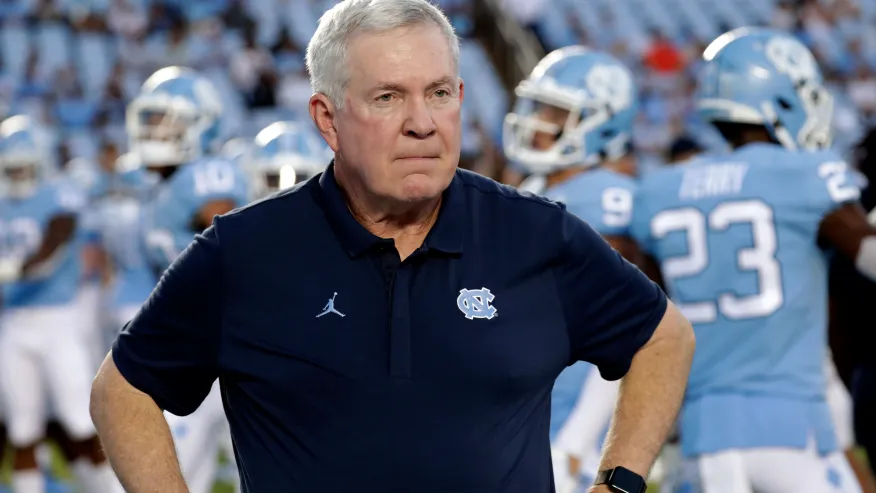
The bitter irony wasn’t lost on the UNC community watching Monday night’s debacle unfold. Just one day after Mack Brown expressed his intention to return in 2025, UNC fired him, painting the 73-year-old coach as the primary obstacle to the program’s success. The administration’s messaging was clear: Brown was the problem that needed solving.
Now, after witnessing Belichick’s team collapse in such spectacular fashion, many UNC fans who were disappointed to see Mack Brown go are pointing out the talent the head coach brought to Tar Heel football. The contrast is stark and embarrassing for an administration that positioned Brown’s departure as a necessary step toward respectability.
Brown, for his part, has handled his dismissal with the kind of grace and accountability that was conspicuously absent from Monday night’s postgame theater. His recent comments about UNC lowering academic standards and increasing financial commitments to help Belichick succeed weren’t delivered as vindictive shots but rather as observations about institutional changes he was never afforded.
The community sentiment has shifted dramatically. Fans were already divided over UNC’s contentious firing of the legendary Brown, but Monday’s performance has crystallized the growing sense that the administration scapegoated a coach who was demonstrably accountable as a leader. Brown’s teams may not have reached championship levels, but they never suffered the kind of comprehensive, preparation-based collapse that characterized the TCU loss (with the exception of the JMU game).
The embarrassment runs deeper than a single game result. It’s the embarrassment of an administration that convinced itself—and tried to convince its fanbase—that Brown’s steady, if unspectacular, leadership was somehow inferior to the mythology of a big name hire. The UNC community is now confronting the uncomfortable reality that they may have jettisoned authentic leadership for the hollow promise of celebrity coaching.
The Road Forward and Lessons in Humility
This loss should serve as a necessary corrective to the breathless coverage that surrounded Belichick’s hiring. Coaching greatness doesn’t transfer automatically across contexts, and the skills that make someone exceptional at managing professional athletes don’t necessarily translate to developing college players.
The challenge for Belichick moving forward isn’t just about adjusting his tactical approach or improving his team’s execution. It’s about demonstrating the kind of authentic accountability and substantive analysis that his postgame performance so conspicuously lacked. College football fans—and particularly UNC fans who have endured years of mediocrity—deserve more than generic platitudes and deflection when their team suffers such a comprehensive defeat.
The mythology of Bill Belichick will eventually give way to the reality of what he can actually accomplish within the unique constraints and opportunities of college football. Monday night’s opener provided a stark reminder that reputations, no matter how well-earned in other contexts, must be rebuilt from scratch when the game changes. And none of these UNC legends or stars can help this team on the field (though we absolutely adore their enduring presence): Michael Jordan, Lawrence Taylor, Roy Williams, Julius Peppers, Mia Hamm, Randy Moss, Eric Church, or Chase Rice. The question now is whether Belichick possesses the humility and adaptability to learn from this failure, or whether his postgame performance—substance-free and accountability-averse—represents the template for how he’ll handle adversity in his new role.
For a program desperate for credibility and a fanbase starved for authentic leadership, that question may prove more important than any single game result.
Full breakdown of UNC’s 48–14 loss to TCU, with grades integrated
🏈 Position Group Breakdown (With Grades)
🔹 Quarterback – Grade: D
- Gio Lopez led an impressive 83-yard TD drive early, but the rest was disastrous.
- Held the ball too long, threw late, and failed to escape pressure consistently.
- Threw a pick-six, then fumbled on a sack—returned for another TCU touchdown.
- Struggled reading coverages and delivering in rhythm; later exited with injury.
- Max Johnson entered and looked poised:
- 9-of-11 for 103 yards, 1 TD.
- Offense flowed better with short, quick throws and simplified concepts.
🔹 Running Backs – Grade: C‑
- UNC totaled only 50 rushing yards on 27 carries (1.8 YPC)—a non-factor all game.
- Caleb Hood scored the lone offensive TD but had just 31 yards on 10 carries.
- Benjamin Hall showed some promise in limited touches, running with balance and toughness—looked like someone who may deserve more carries going forward.
- Still, no back created explosive plays, and the unit was swallowed up by TCU’s front due to poor blocking and penetration.
- Pass protection from backs was inconsistent; little help in the screen or checkdown game.
🔹 Wide Receivers / Tight Ends – Grade: C+
- Jordan Shipp shined: 4 catches for 84 yards; physical and confident.
- Other WRs contributed little—drops, route confusion, and lack of separation plagued the unit.
- Tight ends were non-factors in the passing game and struggled in blocking assignments.
🔹 Offensive Line – Grade: D
- Inconsistent across the board, especially from underclassmen.
- True freshmen:
- Eidan Buchanan: 43.7 offense grade, 52.8 run-block.
- Aidan Banfield: 49.7 offense, 48.9 run-block.
- Frequently lost 1-on-1 matchups, struggled to pick up stunts and blitzes.
- No push in the run game, and pass pro gave QBs little time or confidence.
🔹 Defensive Line – Grade: D‑
- Zero tackles for loss. Zero sacks. One QB hit.
- TCU ran for 258 yards (7.4 YPC)—dominant in the trenches.
- No gap discipline, poor leverage, and minimal physicality.
- Couldn’t generate pressure even when UNC blitzed.
🔹 Linebackers – Grade: C
- Flashes of sound play, but not enough consistency.
- Missed tackles and late reads contributed to TCU’s chunk yardage.
- Often caught out of position when TCU went uptempo or misdirected.
🔹 Secondary – Grade: D‑
- Multiple coverage busts, especially in zone.
- Allowed 284 passing yards, with TCU QBs mostly unpressured.
- Poor communication and tackling in the open field.
- No ball disruption or playmaking to help flip momentum.
🔹 Special Teams – Grade: C‑
- Sloppy execution:
- Mishandled punt snap hurt early momentum.
- Kick coverage gave up good field position.
- No explosive return plays.
- Kicking game wasn’t a disaster, but did nothing to flip the game either.
📋 Scheme & Execution Issues
- Offense was overly rigid and predictable:
- No adjustments made to support Lopez’s strengths.
- Designed QB runs and RPOs were nearly absent despite Lopez’s mobility.
- When Johnson entered, the offense shifted to quick passes and timing routes—worked far better.
- Defense was passive and reactive:
- No pressure packages worked; soft coverages left big holes.
- No disguises, little rotation, and poor sideline adjustments.
- UNC looked slower, less physical, and unprepared across both sides of the ball.
- Self-inflicted wounds — turnovers, blown coverages, drops — made it impossible to regain footing.
🧠 Coaching & Strategic Breakdown
🔹 Coaching Staff Grade: D+
- Offensive game plan failed to evolve:
- Freddie Kitchens stuck with ineffective deep passing game too long.
- Didn’t lean into tempo or quick throws until the game was out of hand.
- Defensive plan lacked aggression or creativity.
- No disguised coverages or exotic blitzes—TCU knew what was coming.
- Bill Belichick looked uncharacteristically unsettled on the sideline:
- Struggled managing player rotations and emotional tone.
- Post-game acknowledged failures in “all three phases” and said: “We were outplayed, outcoached, and out-executed. We all have to do a better job.”
- This loss highlighted a major cultural adjustment to the college game—recruiting, player development, and motivation are vastly different than the NFL.
📌 Quick Reference Summary Table
| Unit | Grade | Key Issues |
|---|---|---|
| Quarterbacks | D | Lopez held ball, late throws, no escapability |
| Running Backs | C‑ | Ineffective as a unit; Hood scored early but bottled up. Hall showed potential on limited carries |
| Wide Receivers/TEs | C+ | Drops, few weapons beyond Shipp |
| Offensive Line | D | Beaten physically, poor assignments and grade out |
| Defensive Line | D‑ | No pressure, gashed in run game |
| Linebackers | C | Inconsistent reads, missed tackles |
| Secondary | D‑ | Coverage breakdowns, poor tackling |
| Special Teams | C‑ | Mental mistakes, minimal impact |
| Coaching | D+ | Weak adjustments, flat energy |
⚠️ Final Verdict
This wasn’t just a talent mismatch—it was a complete systems failure. UNC under Belichick was supposed to embody discipline, physicality, and sound fundamentals. Instead, they were outplayed at every level.
The good news? There’s time. But without fast improvement, UNC’s rebuild under Belichick could get far worse before it gets better.