
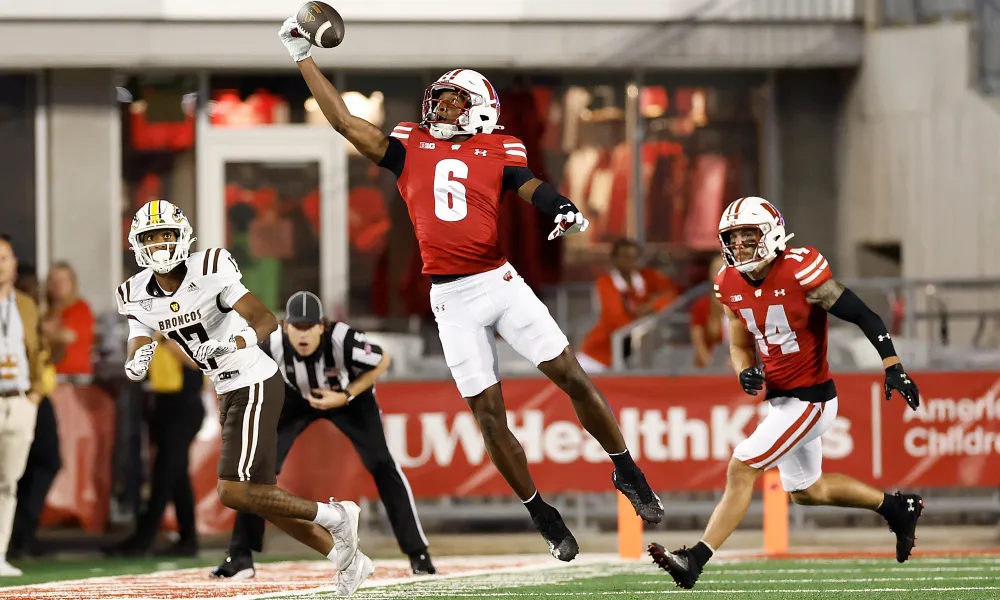
Xavier Lucas, a promising defensive back formerly with the University of Wisconsin, has taken a groundbreaking step by transferring to the University of Miami without entering the NCAA transfer portal. This unprecedented action challenges the very foundations of the NCAA’s transfer system and could pave the way for significant changes in how student-athletes move between schools.
The Standoff: Wisconsin’s Unprecedented Refusal
Lucas’s journey from Wisconsin to Miami was far from conventional. After a strong freshman campaign with the Badgers in 2024, Lucas announced in December that he intended to transfer closer to his Florida home. However, a roadblock quickly arose: Wisconsin refused to enter his name into the transfer portal. The reason? A two-year revenue-sharing agreement Lucas had signed with the university.
Under NCAA regulations, schools are required to add a player’s name to the transfer portal within two business days of receiving a request. Wisconsin’s failure to do so left Lucas in a state of limbo, unable to communicate with potential suitors and with the transfer window quickly closing.
In the face of this deadlock, Lucas and his attorney, Darren Heitner, initially explored legal options, including an antitrust lawsuit against both Wisconsin and the NCAA. But Lucas, rather than waiting for a legal resolution, took matters into his own hands. He unenrolled from Wisconsin and immediately enrolled at the University of Miami—a move that appears to sidestep the NCAA’s established transfer rules entirely.
NCAA’s Unlikely Validation
On January 17, 2025, the NCAA issued a statement that could ultimately validate Lucas’s unconventional transfer method. The organization clarified that its rules “do not prevent a student-athlete from unenrolling from an institution, enrolling at a new institution, and competing immediately.” This statement effectively legitimizes Lucas’s actions, as he managed to bypass the transfer portal altogether and still found a new home at Miami.
What does this mean for college athletics? It could signal the end of the transfer portal’s dominance in the sport. The portal, which was introduced to streamline the process of player transfers, may no longer hold the same weight if players can bypass it entirely, as Lucas has done. Moreover, it raises questions about the enforceability of revenue-sharing agreements between schools and athletes, particularly those tied to NIL (name, image, and likeness) deals.
The Ripple Effect: A Potential Game-Changer
Lucas’s decision could have far-reaching implications for college football and college sports in general. His ability to transfer without the portal challenges the very system that has governed player movement since its creation. The NCAA may be forced to reevaluate the role of the transfer portal, particularly if more athletes follow in Lucas’s footsteps.
Beyond the portal, this situation also casts a spotlight on the increasingly complex landscape of NIL agreements and how they intersect with traditional scholarship agreements. Lucas’s revenue-sharing deal with Wisconsin, which was never honored financially, raises questions about the legal enforceability of such agreements and whether athletes are being unfairly restricted by these deals.
If Lucas’s actions set a precedent, we could see a shift in how schools approach NIL agreements and transfer requests. The NCAA, which has struggled to keep pace with the rapid changes in college athletics, may need to overhaul its transfer regulations to accommodate these new realities.
The Background: A Rising Star in College Football
Xavier Lucas’s story is one of resilience and determination. The 4-star recruit from Pompano Beach, Florida, had a strong freshman season with Wisconsin, recording 18 tackles, two tackles for loss, and one interception in 12 games. His potential for a starting role in 2025 was clear, and his desire to return home to Florida was understandable.
Lucas’s situation is not just about a player transferring for personal reasons; it underscores the growing tension between traditional college football structures and the new realities of NIL, transfer rules, and the growing power of student-athletes. Lucas’s move could very well be the spark that ignites a broader conversation about how the NCAA and schools handle player movement in the modern era.
What’s Next for Lucas and College Football?
The future remains uncertain for both Xavier Lucas and the broader college football community. Will more athletes follow Lucas’s lead and find ways to bypass the portal? How will the NCAA respond to this challenge to its authority? And most importantly, will this case set a precedent for future transfer disputes? How will this impact future recruits views of Wisconsin?
While Lucas’s transfer may seem like an isolated incident, its potential impact on college football cannot be overstated. The NCAA’s acknowledgment of his decision to transfer without using the portal signals a shift in the way the governing body views player mobility. If other athletes take similar actions, the entire transfer process could be overhauled, forcing schools and the NCAA to reconsider how they manage player movement.
As college athletics continues to evolve, the landscape is being reshaped by athletes like Xavier Lucas—athletes who are not afraid to challenge the status quo and push for change. Lucas’s bold move could very well be the first step toward a new era of player empowerment in college sports, where the rules are written by the players, not the institutions. And there is an underlying constraint to be addressed here also, where the University of Wisconsin’s interpretation of the revenue-sharing agreement harkens back to the days of old, where schools felt empowered to leave players with a feeling of entrapment due to intentional refusal to release.
In the end, the transfer portal (often referred to as the wild wild west) may no longer be the gatekeeper it was intended to be, and Lucas’s groundbreaking decision may be the catalyst for a new era of personal choice in college athletics.