
The Olympic Games are designed to showcase the outer limits of human performance. But every so often, they also illuminate something deeper: the intersection of sport, identity, and citizenship.
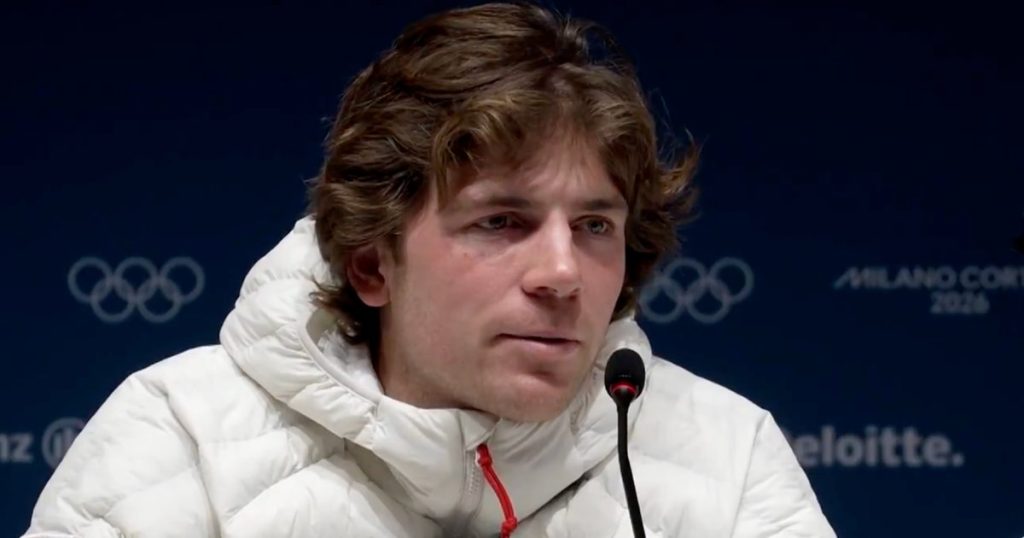
American freeskier Hunter Hess found himself at the center of a national conversation after addressing U.S. immigration enforcement policies during media availability at the Winter Games. In response to a question about developments back home, Hess remarked that wearing the American flag “doesn’t mean I represent everything that’s going on in the U.S.” The comment, brief and measured, quickly traveled far beyond the mountains of Livigno.
The following day, the U.S. President publicly criticized Hess on Truth Social, amplifying the moment and drawing sharp reactions across social platforms and cable news panels. What could have remained a routine post-event exchange instead became a flashpoint, reframing the narrative from competition to commentary.
Yet inside the Olympic Village and along the training runs, the tone was notably different.
Several fellow athletes voiced support for Hess, not necessarily as an endorsement of a specific policy position, but in defense of a broader principle: that representing one’s country and retaining individual perspective are not mutually exclusive. Two-time Olympic gold medalist Chloe Kim emphasized solidarity, noting that athletes can take pride in wearing Team USA colors while still maintaining the freedom to speak from personal experience. Eileen Gu, the American-born freeskier competing for China and no stranger to scrutiny herself, characterized the episode as an unfortunate distraction from the competition and shared that she had reached out to Hess directly.
Their responses reflected something often overlooked in these moments. Athletes exist in dual roles. They are ambassadors in uniform, but they are also citizens shaped by family histories, communities, and lived experience. The Olympic stage magnifies both.
The reaction across the United States has been varied, revealing how deeply invested Americans remain in both sport and civic life. For some, the Games are sacred ground reserved solely for competition. For others, athletes are participants in the broader national story, with voices that inevitably extend beyond the field of play.
This tension is not new. From Muhammad Ali to Tommie Smith and John Carlos to more contemporary figures across leagues and sports, the boundary between athletic excellence and civic expression has long been porous. The difference now is velocity. In a digital era, a single sentence can circle the globe before the medals are even awarded.
Still, amid the headlines, the competition continues. Athletes train. Heats are contested. Podiums are claimed. And the American flag is raised by competitors who carry with it not uniformity of thought, but a shared commitment to represent.
What this episode ultimately underscores is a familiar American dynamic: the ongoing effort to balance national pride with individual expression. Both are foundational threads in the country’s fabric. Both are visible on the Olympic stage.
In Livigno, as snow continues to fall and the world’s best carve their lines into it, that balance remains as complex as ever. But so, too, does the spirit of unity that brings athletes together in the first place.