
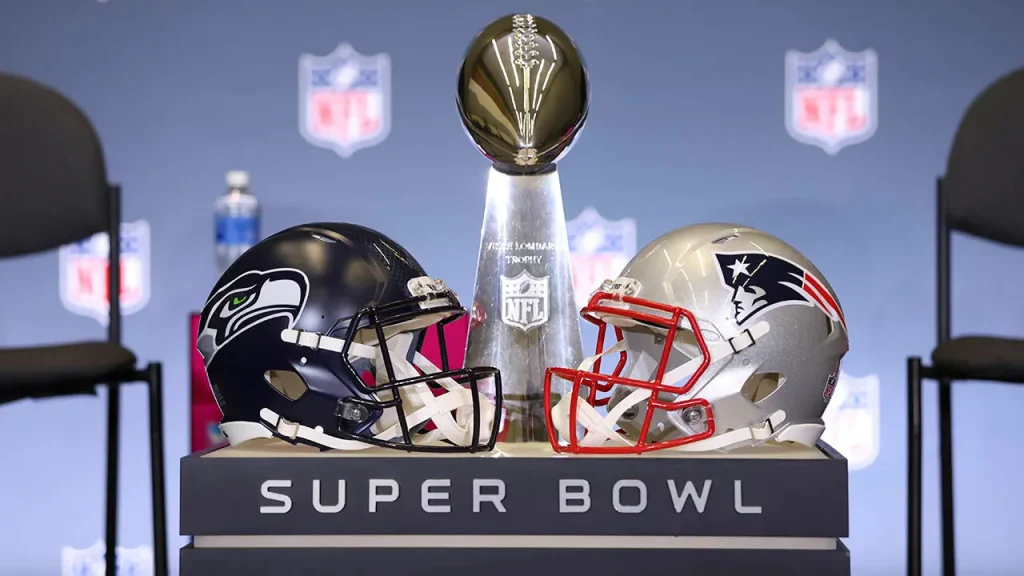
Super Bowl LX brings together the league’s most dominant defense, its most improbable turnaround, and a betting market that’s daring you to pick a side. As Bad Bunny would say, “I don’t chase success, I chase happiness,” and on Super Bowl LX’s biggest stage, that sentiment might just apply to more than the halftime show.

The Seattle Seahawks (16–3) arrive at Super Bowl LX at Levi’s Stadium as 4.5-point favorites over the New England Patriots (17–3), with the total set at 45.5 points. Behind the resurgence of quarterback Sam Darnold and a league-leading defense engineered by second-year head coach Mike Macdonald, Seattle has emerged as the most complete team in football. The Seahawks allowed a league-best 17.2 points per game and carry an implied win probability of roughly 60 percent, with sharp money pushing the spread from an opening line of Seahawks –3.5 to its current position.
New England’s presence on this stage underscores one of the league’s most improbable turnarounds. Under head coach Mike Vrabel and rookie quarterback Drake Maye, who threw 31 touchdowns against just eight interceptions, the Patriots completed a worst-to-first ascent and now seek an unprecedented seventh Super Bowl title. While Seattle holds the edge across most advanced metrics—highlighted by the NFL’s best interior defensive line and the league’s lowest yards per carry allowed (3.7)—betting analysts have noted a compelling trend: underdogs have covered in five consecutive Super Bowls, making Patriots +4.5 a popular contrarian position.
The matchup also revisits one of the Super Bowl’s most enduring moments. In Super Bowl XLIX, Malcolm Butler’s iconic goal-line interception sealed a 28–24 Patriots victory and denied Seattle a second straight championship. That memory looms large as the Seahawks seek redemption, while New England looks to establish a new dynasty in the post-Brady era. Both teams entered the season as longshots—Seattle at 60-1, New England at 80-1—setting the stage for a championship that blends elite defense with narrative gravity.
Seattle’s defensive foundation begins up front. Defensive tackles Leonard Williams, a 2025 second-team All-Pro, and rookie first-round pick Byron Murphy III form the league’s most disruptive interior duo among 300-pound linemen, combining for 108 quarterback pressures, 35 quarterback hits, and 14.0 sacks. On the other side of the ball, Offensive Player of the Year Jaxon Smith-Njigba draws a premier matchup against cornerback Christian Gonzalez, who has not allowed more than 67 receiving yards in a game this season and has surrendered just one touchdown all year.
The Seahawks’ postseason surge has also been fueled by Kenneth Walker III. The fourth-year running back is averaging 4.7 yards per carry with four rushing touchdowns in two playoff games, including a three-touchdown performance against San Francisco that tied a franchise postseason record. Walker has totaled 256 yards from scrimmage in the playoffs and caught all seven of his targets for 78 yards, anchoring a revitalized rushing attack that has eclipsed 120 rushing yards in eight of Seattle’s last nine games.
For New England, the offensive identity has leaned heavily on Rhamondre Stevenson, who has dominated the backfield workload with 51 postseason carries compared to rookie TreVeyon Henderson’s 24. Gonzalez headlines a disciplined secondary tasked with containing Seattle’s explosive passing game, while veteran wideouts Mack Hollins and Stefon Diggs, who posted 85 receptions for 1,013 yards and four touchdowns, provide situational reliability and leadership in high-leverage moments.
Super Bowl LX ultimately presents a compelling contrast: Seattle’s defensive dominance and balance against New England’s momentum, efficiency, and belief. Whether the night ends in redemption or the birth of another Patriots era, the matchup promises tension, legacy, and a fitting close to a season defined by defied expectations.
Seattle Takes Super Bowl LX
In the end, the Seattle Seahawks captured Super Bowl LX with a commanding display of defensive dominance and a bruising, composed performance from running back Kenneth Walker III in a decisive victory over the New England Patriots. Seattle’s defense dictated the game from the outset, forcing turnovers, collapsing the pocket, and controlling the tempo with disciplined aggression. Meanwhile, Walker blended patience with explosiveness, punishing defenders between the tackles before breaking free for momentum-shifting gains that sustained drives and drained the clock. His balance of speed and power provided the offensive anchor Seattle needed and perfectly complemented a relentless defensive front. It was a championship formula the Seahawks know well, physical, poised, and punishing, delivering another Lombardi Trophy back to the Pacific Northwest.