
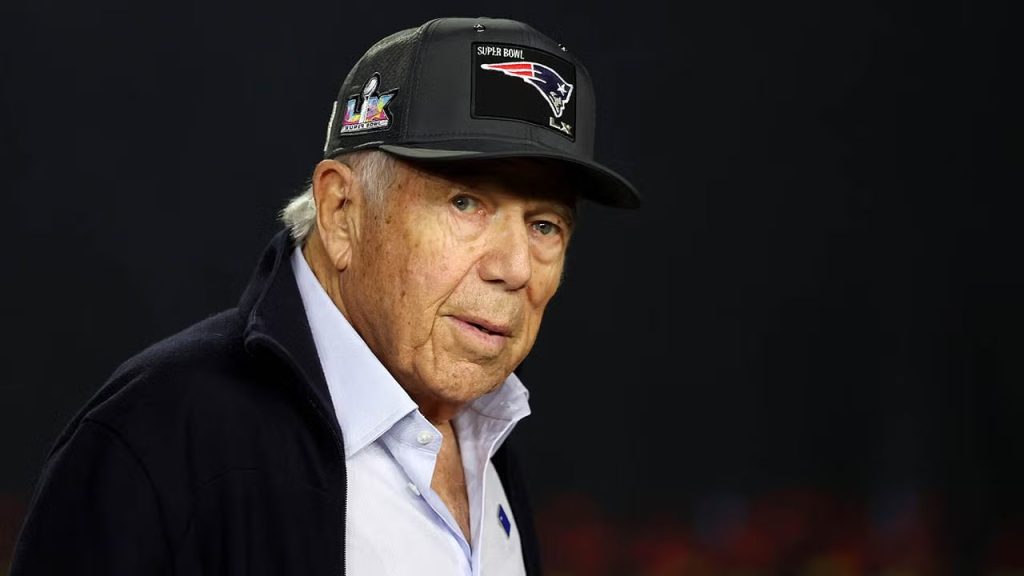
Robert Kraft is widely recognized as one of the most successful owners in professional sports history, having transformed the New England Patriots into a dynasty that secured six Super Bowl championships. His leadership has been honored with the 2022 Sports Business Journal Lifetime Achievement Award and the NCAA’s Theodore Roosevelt Award, the association’s highest honor for a distinguished citizen. Beyond the field, he is a prominent philanthropist, receiving the Genesis Prize for his work against antisemitism and the Ron Burton Humanitarian Award for his extensive community service.
So why was his merit not enough?
Look, I’ve never been one to shy away from tough conversations, and this is one we need to have. What happened with Bill Belichick and what’s happening now with Robert Kraft isn’t just disappointing: it’s a disservice to the game we all love.

Let me say this up front: I’ve witnessed plenty of games where Bill Belichick’s teams have broken my heart as a fan of competition and drama. I’ve questioned decisions, criticized game plans, and yes, been tough on the guy when I thought it was warranted. But I’ve always tried to be fair. And this? An eight-time Super Bowl champion who built two separate dynasties, not making it on the first ballot? That’s not about football. That can’t be about football.
The precedent here matters. When you examine the criteria historically applied to coaches with multiple championships, the pattern is clear: first-ballot induction has been the standard. Tom Landry, Chuck Noll, Bill Walsh—all entered on their first year of eligibility. Belichick’s résumé doesn’t just meet that threshold; it exceeds it. So if merit isn’t the issue, and the data suggests it clearly isn’t, then what are we really talking about here? We’re talking about something that should concern anyone who cares about institutional credibility: the politicization of what should be an objective process.
I get that relationships and conduct matter in any professional evaluation. But when personal grievances begin to outweigh measurable achievement, you’ve introduced a variable that undermines the entire framework. The Hall of Fame’s value proposition rests on one fundamental promise: that excellence will be recognized on its merits. When that promise breaks down, so does trust in the institution.
And now, today, we’re hearing that Robert Kraft has fallen short for the Class of 2026. Let me put this in perspective with the numbers, because they tell a compelling story. When Kraft bought the Patriots in 1994, they had won 225 games in their entire history. Since then? 374 wins. Six Super Bowl championships. Beyond the wins, consider the organizational transformation: a franchise on the brink of relocation became a model for sustained excellence, infrastructure investment, and league-wide innovation. He’s been nominated since 2013. That’s over a decade of demonstrated impact being overlooked.
I’m not naive about how these processes work. The Hall of Fame considers multiple factors: competitive success, yes, but also contributions to the game’s growth, leadership during critical moments, and lasting institutional impact. By every one of these measures, Kraft’s case is substantial. His influence extends beyond his franchise to how owners across the league approach team building, stadium development, and business operations.
Here’s what concerns me from a structural standpoint: we’re living in an era where the evaluation criteria appear inconsistent depending on who’s being assessed. I’ve spent my career trying to be objective, building frameworks for analysis that separate personal feelings from performance metrics. But when I see decision-makers doing the opposite, when I see documented excellence being delayed or denied due to factors unrelated to contribution, it exposes a flaw in the governance model.
The Hall of Fame’s legitimacy depends on maintaining clear, defensible standards. It should operate as a meritocracy where the benchmark for entry is transparent and consistently applied. Bill Belichick met that benchmark. Robert Kraft met that benchmark. Their contributions are quantifiable, their legacies documentable regardless of a gold jacket.
But the larger issue transcends individual cases. When any institution allows subjective bias to override objective criteria, it creates a precedent that erodes confidence in future decisions. The question becomes: what message does this send to current coaches and executives about how their legacies will be evaluated? That excellence isn’t enough? That relationships with voters matter more than results? That’s a dangerous path for any organization that claims to honor merit.
The Hall of Fame has an opportunity here to course-correct, to recommit to the principles that give it meaning. This isn’t about sentimentality or emotion. It’s about protecting the integrity of an institution that belongs to the sport itself. When the standards become unclear or appear to shift based on personal dynamics, everyone loses: the candidates, the voters, and most importantly, the game.
I love this game too much to watch it become about anything other than what happens between the lines and the people who made it great. And right now, with these two decisions, we’re at a crossroads. This isn’t about lobbying for specific individuals. It’s about ensuring that the process itself remains worthy of the legends it’s meant to honor.
Sometimes leadership requires calling out what isn’t working, even when it’s uncomfortable. This process isn’t working. And I hope the people who control it recognize that protecting its integrity means making decisions that can withstand scrutiny, not just survive a vote behind closed doors.
