
In one of the most remarkable stories in college football history, the Indiana Hoosiers completed a perfect 16-0 season by defeating Miami 27-21 in the College Football Playoff National Championship on Monday night at Hard Rock Stadium. The victory marked Indiana’s first national championship and capped a transformation that saw the program rise from 715 all-time losses, the second most in FBS history, to college football’s ultimate underdog story.
The Championship Game
The title game came down to a defining moment. Facing fourth-and-4 from the Miami 12 with the Hoosiers up three points, head coach Curt Cignetti made the gutsy decision to go for it rather than kick a field goal. Heisman Trophy-winning quarterback Fernando Mendoza’s tackle-breaking 12-yard run gave Indiana breathing room with 9:27 remaining in the game.
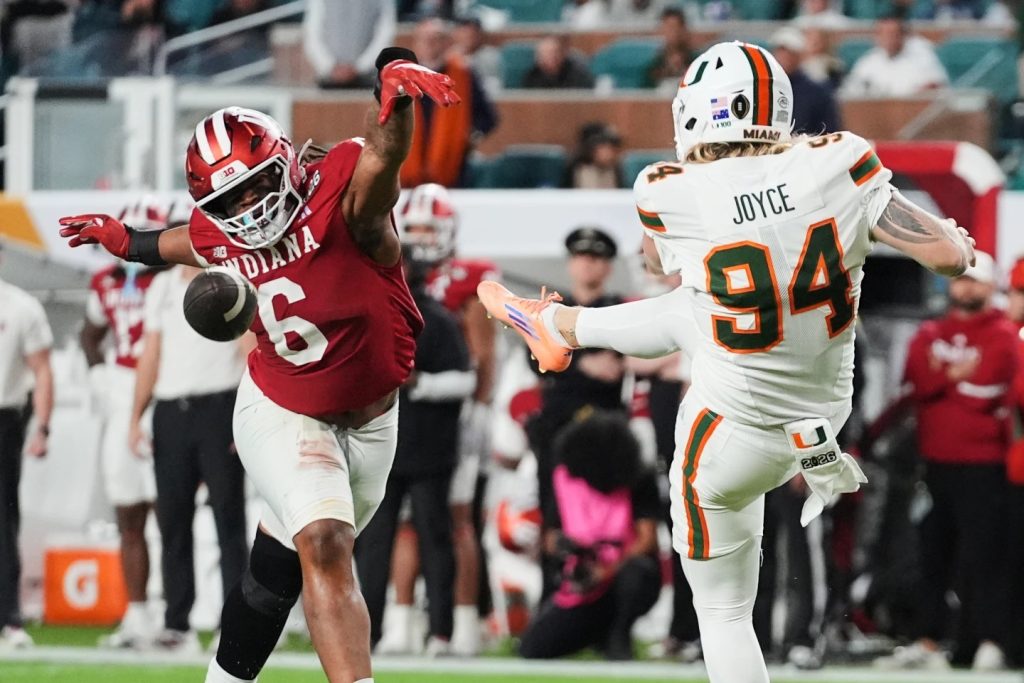
Defensive lineman Mikail Kamara earned Defensive MVP honors for his blocked punt that gave Indiana a 17-7 lead in the third quarter. Big plays often decide the margin of victory in sports, swinging points or field position and directly shaping the final score. Kamara’s blocked punt off Miami’s Dylan Joyce delivered such a moment when it was immediately recovered by Isaiah Jones for a touchdown. Acknowledging the pain of this moment for the ‘Canes, success belongs to those who recognize a kairos moment, possess the preparation to seize it, and execute without hesitation when the moment arrives.
The game was sealed when Jamari Sharpe intercepted Carson Beck in the final minute, triggering celebrations across Bloomington and among cream-and-crimson clad fans who outnumbered Miami supporters in their own stadium.
Mendoza was named Offensive MVP after completing 16 of 27 passes for 186 yards, a fitting conclusion to his spectacular season. The Miami native won the championship in his hometown, against the school that never recruited him, adding a layer of personal redemption to the historic achievement.

The Improbable Journey
Indiana became the first major college team since Yale in 1894 to go 16-0, accomplishing what many thought impossible in the expanded 12-team playoff era. The journey featured several signature moments:
- Dominant Playoff Run: Indiana did not just win; they crushed opponents. The Hoosiers became the first team in CFP history to win two playoff games by 28-plus points, beating Alabama 38-3 in the Rose Bowl and Oregon 56-22 in the Peach Bowl semifinal.
- Big Ten Championship: Indiana defeated Ohio State 13-10 to claim their first Big Ten title since 1967, with Mendoza delivering a crucial 17-yard touchdown pass in the clutch.
- Historic Season Statistics: Indiana defeated five AP top-10 opponents, joining elite company alongside programs like 2019 LSU and 2024 Ohio State. Mendoza threw 41 touchdowns, finishing as the only FBS player this season to surpass 40 passing scores, and became the eighth Heisman winner to capture a national championship.
The Cignetti Effect
Head coach Curt Cignetti compiled a 27-2 record in his first two seasons at Indiana, transforming a program that had never won 10 games in a season into national champions. His confidence was infectious from day one, famously telling reporters at his introductory press conference to “Google me, I win.”
Cignetti’s willingness to take risks defined Indiana’s season, especially that fourth-down call in the championship game. Offensive tackle Carter Smith recalled that when the kicking unit started onto the field, Cignetti yelled, “Get off the field! We’re going for it.”
Miami’s Improbable Run: From Doubted to Dynasty Chasers
While Indiana wrote the ultimate Cinderella story, Miami’s journey to the championship was remarkable in its own right, full of resilience and redemption.
The Road to Miami
Miami barely made the playoff. The Hurricanes finished 10-2 in the regular season after losses to Louisville and SMU, with the latter in overtime dropping them to No. 18 in the polls. They secured an at-large bid as the No. 10 seed, sneaking in as the final team selected amid debate about their legitimacy.
Three Distinct Victories
Miami’s playoff run showcased versatility and grit:
- First Round vs. Texas A&M (10-3): In brutal conditions at Kyle Field, Malachi Toney’s 11-yard touchdown reception with under two minutes left provided the only score in a defensive slugfest. The first half was scoreless, the first in CFP history. Mark Fletcher Jr. rushed for a career-high 172 yards, and the defense dominated with seven sacks of Texas A&M quarterback Marcel Reed.
- Quarterfinals vs. Ohio State (24-14): Miami upset the defending national champion Buckeyes at AT&T Stadium on New Year’s Eve, becoming the first double-digit seed to make the CFP semifinals. Legendary figures including Jimmy Johnson, Michael Irvin, and Ray Lewis attended the game.
- Semifinals vs. Ole Miss (31-27): The Hurricanes rallied to defeat Ole Miss in the Fiesta Bowl, surviving six lead changes to advance to the championship game in their home stadium.
The Championship Heartbreak
Playing as the visiting team in their own stadium, Miami battled Indiana throughout but could never take the lead. Mark Fletcher Jr.’s 57-yard touchdown run in the third quarter kept the Hurricanes within striking distance, and a 22-yard touchdown pass from Beck to Malachi Toney cut the deficit to 24-21 with 6:37 remaining.
The comeback fell short. Beck’s interception ended Miami’s season, denying them what would have been their sixth national championship and first since 2001.

The Bigger Picture
Both teams defied expectations in their own ways. Indiana proved that even the sport’s biggest underdogs could become champions with the right leadership and belief. Miami showed that a team written off after November stumbles could battle back and nearly claim college football’s ultimate prize.
Cignetti called it “probably one of the greatest stories of all time,” and for Indiana, it certainly was. Miami’s run from the last playoff team to playing for a national championship in their own stadium, winning three consecutive road games against elite opponents, will be remembered as one of the most improbable runs in recent memory, even if it ultimately fell just short of the ultimate prize.